Friday, October 29, 2010

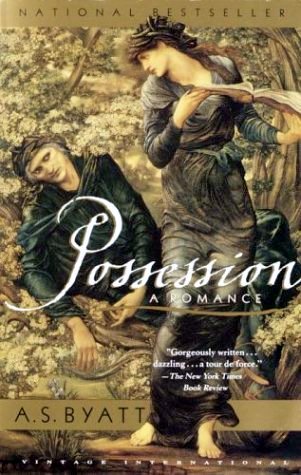
A.S. Byatt's Poetic Justices


Taking a step back, it's unnerving to imagine what A.S. Byatt's 1990 novel Possession could have been had it been written by someone else. When its themes, genres, and progressions are taken at strict superficial value, we're presented with a book that is heavy on genre fiction, from mystery to thriller, a slight dash of paranormal implications, and a group of characters that virtually wear signs that read "heroic" or "villainous." The full title is Possession: A Romance, and there's plenty of that, from the classic definitions to the contemporary notions. Perhaps I'm beating around the bush--the elements of this novel could have been combined to create a terrible piece, or a work that would be looked at as heavy on the potential, but lacking serious substance. However, when taken in after a full reading, it's just as easy to see how talented A.S. Byatt is as a novelist.

Possession tells the story of Roland Michell and Maud Bailey, two young scholars who come together to research the previously unknown romance between two regarded Victorian poets, Henry Randolph Ash and Christabel LaMotte. Michell is a research assistant to an English Ash scholar, and during his research, he comes across two undated drafts of a letter to a female acquaintance, written in Ash's handwriting. They aren't exactly love letters, but they are undocumented pieces and do hint to the possibility of emotions beyond regular salutations.

"Dear Madam,
Since our extraordinary conversation I have thought of nothing else. It has not often been given to me as a poet, it is perhaps not often given to human beings, to find such ready sympathy, such wit and judgment together. I write with a strong sense of the necessity of continuing our talk, and without premeditation....to ask if it would be possible for me to call on you, perhaps one day next week
(Byatt 7)."

Through his inquiries, Roland hypothesizes that Ash's letters were written to LaMotte, and he meets Maud, a feminist scholar, and even before they meet, when her name is first mentioned, the reader has a feeling that something will blossom between the two characters. They're joined by a passion for their respective subjects, and, much like the uncovered romance between the two deceased poets, the reader has to be patient and wait for revelations to be unfolded. Sure, most of them may seem obvious, but Byatt is careful to balance the expected plot developments with the occasional unexpected twist. Once Roland and Maud begin their joint research, the project takes them to LaMotte's former home, where more letters are unearthed. The potential revelations are sure to have a domino effect throughout the literary field, since Ash was supposedly devoted to his wife, and LaMotte, while herself a gifted feminist poet, was thought to have lived her life in social and sexual seclusion. Much like a classic British drama, more characters are introduced, all of whom have their own interests and agendas in the Ash-LaMotte correspondence. In returning to the notion of the "heroic" and "villainous" characters, an excellent example is the terrifically named Mortimer Cropper, an American rival of the professor (James Blackadder) who employs Roland. His introduction is such that, while he's a definite foil, he's created in very sly, revealing tones.

"His face in the mirror was fine and precise, his silver hair most exquisitely and severely cut, his half-glasses gold-rimmed, his mouth pursed, but pursed in American, more generous than English pursing, ready for broader vowels and less mincing sounds. His body was long and lean and trim; he had American hips, ready for a neat belt and the faraway ghost of a gunbelt (Byatt 105)."


For such a varied plot, Byatt's writing shines in various formats. To begin with the most stunning example, she meticulously "reprints" pages upon pages of poems that were written by the fictional poets. This goes beyond a simple recreation. The poems are beautifully crafted and could easily be actual Victorian citations, not just well-crafted homages to the style. While nobody could blame her for showing off, she's not doing so. Byatt's poems compliment the novel, adding further metaphors to the imagined letters between Ash and LaMotte. To have written such a complex, nuanced novel without fictionalized poetry is a marvel; the combination of the two alone, in this single book, is enough to elevate Byatt's placement among the world's best novelists, male or female.

"What is a House? So strong--so square
Making a Warmth inside the Winds
We walk with lowered eyelids there
And silent go--behind the blinds

Yet hearts may tap like loaded bombs
Yet brains may shrill in carpet-hush
And windows fly from silent rooms
And walls break outwards--with a rush--

-CHRISTABEL LaMOTTE (Byatt 229)."

Byatt also provides many salutes and winks to the world of academia, specifically in the field of literary and poetic studies. Anyone who has spent any time in a university English Department will appreciate the sometimes tedious nature of research and the understanding that business and funding can sometimes usurp creativity and the bigger picture. The new histories that Roland and Maud uncover, and the way it unfolds, is done very dramatically, almost wistfully. The reality is that a major discovery like that would almost never happen, and the ensuing drama, while sexy, would likely be wishful thinking in real life. However, Byatt rarely veers into truly unrealistic happenings. The bulk of Possession is devoted to the poems and letters of the poets, with the plot serving as a link between the chronology. So while most English majors and PhD candidates would love to have an adventure like Roland and Maud's, the reality is that the true excitement comes from the reading and the research. This serves as excellent ammunition to people who view the Humanities as a waste of time and money. This skepticism is vocalized more than once in the novel, along with the realistic tedium that flares up in even the most passionate personal studies.

"'Funny way to spend your life, though, studying another chap's versifying. We had a sort of poet in this house once. I expect you'd think nothing to her. Terrible sentimental stuff about God and Death and the dew and fairies. Nauseating (Byatt 88).'"

"Much of his writing met this fate. It was set down, depersonalised, and then erased. Much of his time was spent deciding whether or not to erase things. He usually did (Byatt 325)."

Could some of the letters and poems been scaled back, quantity-wise? It's possible, but then again, it would have taken away from Byatt's definite, albeit fictionalized, bibliography. The Victorian words, poems, and even the names of critical texts feel terrifically authentic, and much like real bibliographies, sometimes the extent can be daunting, if not exasperating. This intense attention to detail, coupled with the beautiful writing, is what elevates Possession beyond the aforementioned realm of disposable genre fiction. For a work so steeped in the classics, it's definitely experimental even in the face of the classic story arc. However, while many writers would have the audacity to attempt this, only a select few would be able to make it feel this authentic. There are many plot elements that I haven't explored in this essay, but much like what the characters go through, the joy is in the surprises.

Work Cited:
Byatt, A.S. Possession: A Romance. Copyright 1990 by A.S. Byatt.

Friday, October 22, 2010

"Ill Fares the Land:" Tony Judt's Tough Love


My readings of the late Tony Judt (1948-2010) border, quantity-wise, on the very slim. I've taken in a handful of his essays this past year that were published in The New York Review Of Books, and despite having a lot of catching up to do, his writing style lends itself to a range of feelings. To use a poor metaphor to describe a fine essayist, my introductions to Judt's work was like my introduction to fine scotch. Both educations started off tentatively until the nuances came to fruition, and they took a little bit of time. Judt was a public intellectual in the truest sense, rather than taking the normal pattern of being a talking head. He proved himself to be one of those rare writers with the ability to express complex views while both making them accessible and not dumbing down his tone or language. While it might have made sense to read more of his essays, and therefore gain a better, deeper understanding of his themes, I decided to read Ill Fares the Land, the final book published in his lifetime.

Ill Fares the Land is a rather philosophical look at the sociological, political, and financial woes that have been defining the twenty-first century as of late. This very basic synopsis might make a potential reader take a step back, given that there are literally dozens, if not hundreds of books available that have made attempts to outline or "solve" the American setbacks. Also, much like the political "discourse" as of late, a great too many of these books are carbon-copied conservative screeches and scare-mongering. For a book that has received quiet attention, some of it critical in the past few months, I was struck by how, even with liberal leanings, Judt's writing casts equal blame on both the Left and the Right for the state of the world today. However, said blame never falls into outlandish accusations or name-calling. Judt gives his opinions, but does so with some much-needed constructive criticism. Even from the beginning, the reader gets the feeling that Ill Fares the Land will be an impassioned plea rather than a fall into ridiculous antics. Judt manages to critique both sides in one carefully crafted thought.

"We cannot go on living like this. The little crash of 2008 was a reminder that unregulated capitalism is its own worst enemy: sooner or later it must fall prey to its own excesses and turn again to the state for rescue. But if we do no more than pick up the pieces and carry on as before, we can look forward to greater upheavals in years to come. And yet we seem unable to conceive of alternatives. This too is something new. Until quite recently, public life in liberal societies was conducted in the shadow of a debate between defenders of 'capitalism' and its critics; usually identified with one or another form of 'socialism.' By the 1970s this debate had lost much of its meaning for both sides (Judt 2-3)."

Even in the midst of his histories, examples, and suggestions, Judt makes a recurring theme of the fact that, no matter how saccharine this sentiment may be, we're all in this together. People will always have their own political leanings, the pursuit of wealth will always lends itself to greed and divided classes, and so on and so forth. But, for anybody even remotely interested or concerned about the state of intelligence and communication, Judt's simplicity carries a major punch. From Curtis White to Charles Pierce, I've written about many books that (rightly) decry the lack of intelligence in America's population and mainstream. Judt takes this down a timely path, implicitly decrying the lack of intelligence, but more explicitly decrying the lack of true discourse and discussion in today's political world, especially with all of the problems facing everyone.

"Our disability is discursive: we simply do not know how to talk about these things any more. For the last thirty years, when asking ourselves whether we support a policy, a proposal or an initiative, we have restricted ourselves to issues of profit and loss--economic questions in the narrowest sense. But this is not an instinctive human condition: it is an acquired taste (Judt 34)."

Ideas like these are what elevate this book above the fray; Judt explains that the focus needs to be on human rather than strictly financial levels. However, the financial world needs a lot of work. Using outside quotes and his own views, he states the obvious, yet overlooked, realization that a financial system that consistently widens the gap between the wealthy and the poor is a troublesome system, not one that deserves a shrug and a claim that "oh well, that's capitalism for you...if you don't like it, too bad." He offers his sentiments on the restructuring/redistribution of wealth, but also goes to the basics: economics and finances can be confusing to a layperson (I personally consider myself an excellent example), and not much has been said for more education and understanding of these issues. Again, his writing highlights thoughts that should be common sense but all too often get clouded over.

"Behind every cynical (or merely incompetent) banking executive and trader sits an economist, assuring them (and us) from a position of unchallenged intellectual authority that their actions are publicly useful and should in any case not be subject to collective oversight. Behind that economist and his gullible readers there stand in turn participants in long-dead debates (Judt 105)."


Judt does an excellent job of balancing out his examples. The focus is on the United States, but he does offer historic examples of good and bad financial situations in England, Ireland, and China, to name a few. It goes along with his notion that our current situation simply needs the possibility of what might be outlandish restructuring. At the very least, people need to be open to discussing and thinking about other avenues of change, or other ways of addressing them. If any other public system (he tends to favor and sometimes rely too heavily on the example of public railways) were faltering, it would be relatively easy to address the problem and fix it. But with societies, the ever-growing poor class, and the divide in political life, finding answers can be daunting. However, despite his ease at offering tough, honest condemnations of all political avenues, he does reserve, towards the end, a searing look at the right-wing path and the way discourse is done in that specific arena.

"The perverse effects of this suppression of genuine debate are all around us. In the US today, town hall meetings and 'tea parties' parody and mimic the 18th century originals. Far from opening debate, they close it down. Demagogues tell the crowd what to think; when their phrases are echoed back to them, they boldly announce that they are merely relaying popular sentiment (Judt 172)."

Ill Fares the Land is just as much a written critique of expression as it is of the way society is being run. The above example aside, Judt's argument is that we need to go beyond the traditional paths, as well as explore certain models in their true definitions instead of their twisted meanings in modern discussions (socialism, for example). He's not shy about his opinions, but is also understanding that a lot of people will sit back and assume that everything will right itself again. Divisions between people will always remain, but as he states so eloquently, if they keep growing more strained, the problems that face everyone will only be more divisive. The idea of community has been lost, and its repair is just as, if not more, important as the repair of economic fractures. However, after time, it becomes all too apparent how tightly linked these intangible ideas are.

"If we remain grotesquely unequal, we shall lose all sense of fraternity; and fraternity, for all its fatuity as a political objective, turns out to be the necessary condition of politics itself. The inculcation of a sense of common purpose and mutual dependence has long been regarded as the linchpin of any community. Acting together for a common purpose is the source of enormous satisfaction (Judt 185)."

Another quote from a vastly different source also works as an appropriate closing to these ideas. In an old Calvin & Hobbes strip, in which the two discuss human nature, Calvin asks: "Do you think we'll get smarter?" Hobbes' reply? "That's one of two possibilities."

Work Cited:
Judt, Tony. Ill Fares the Land. Copyright 2010 by Tony Judt.

Tuesday, October 12, 2010

Ill-Fitting Clowes


Even for someone like me, a reader who doesn't partake of many comics or graphic novels, Daniel Clowes is an artist who is at least passingly familiar, which might sound like an insult, but is actually a compliment: Clowes is an artist who has a style that is hard to miss. His cover art for several issues of The New Yorker have been excellent examples of what I take to be his signature: bright colors, a slightly exaggerated comic-book tint, and facial expressions that alternate between bemused and utterly horrified over nothing. The above cover of his latest book, Wilson, is another example. Wilson's head is huge, and his background (both literally and figuratively) is drab and depressing. He's not made out to be hideously ugly, but he's just odd-looking enough to be considered an outsider, and his eyes are drawn to look like he might just burst into tears. No, one should never judge a book by its cover, but the cover of Wilson is both an excellent preview of what's inside, as well as giving nothing about the story away. This immediate contradiction lends itself to the book as well. Wilson is a walking contradiction, a figure both repellent and begging for sympathy.


The opening page of Wilson (above) is entitled "Fellowship." While out walking his dog, he calls himself a people person, and one of his comments refers to another motif in Clowes' work, the balancing of contemporary isolation with the realization that most of our contemporary problems are at times silly.
"Every single one of us has a story to tell, and we're all part of the human family. How tragic that we've lost all sense of community with our fellow man (Clowes 7)!"
Wilson's first interaction leads to a woman bitterly complaining about computer problems, and his misanthropic tendencies are revealed immediately when he asks "For the love of Christ, don't you ever shut up?"
The story follows Wilson through his life, from middle-age to old age, detailing his verbal (and sometimes physical) battles with complete strangers, his family, his ex-wife, and his estranged daughter. The chapters are single paged slices, following a more or less chronological pattern, and most of them end with a typical twist, a "telling-it-like-it-is" moment from Wilson, most of which lead to implied awkward silences. The below passage comes from a conversation between Wilson and his daughter, who was put up for adoption when she was a child, about her adoptive parents. The implication was that Wilson and his ex-wife kidnapped her to either create a perverse composite of a family, or to explore and bring closure to the problems that led to all of them breaking apart to begin with early on. However, the true implication is that Wilson's loner tendencies and psychological problems never would have let them become a normal family.

"And I would hope that raising a child would actually enhance one's sense of community, rather than engendering fear and over-compensatory displays of class and wealth...I mean, Jesus, how many cars does one family need? What kind of example is that? Christ, it's like they're laughing at the next generation! 'Ha ha, I used up all your resources! Fuck you!'...But yeah, they're basically really amazing (Clowes 45)."


In virtually every medium, from film to literature to, in this case, graphic novels, the idea of isolation or personal facades is usually done to mask more honest, underlying problems. However, in Wilson, the character's underlying problems are also his blatant problems. I've only read parts of Clowes' Ghost World, but I've screened Terry Zwigoff's 2001 film version several times. In the film (and, while there are major differences between the film and the book), Enid's sarcasm and hipster outside are used to fend off her feelings of depression and a larger quarter-life crisis. As Wilson gets older, he tries to find happiness with a female neighbor, and learns that he has a grandchild. However, his self-destructive personality makes any sort of relationship doomed from the start. Clowes' writing is witty, dark, and thought-provoking at times; his illustrations are vivid and switch between more "realistic" styles and the intentionally cartoonish. However, for all of the great potential flourishes, Wilson is a work that eventually suffers.

I find it difficult to say that I enjoyed Wilson. The plot is very clear, yet is marked by jumps that, while intended to leave specific events to the imagination, make the linear narrative very unsteady. The emotions work much better when the works are taken as single pieces, much like the last one above. Clowes draws with great visuals and emotion, creating everyday scenes that are as weary and uncomfortable as the, well, everyday. His writing is marked by moments of great dark comedy, creating laugh-out-loud situations in the most unlikely of places. However, Wilson's personality is so abrasive, and his life has taken so many wrong turns, that it's hard to find a balance between the aforementioned sympathy and repulsion. It would be an insult to the reader's intelligence to have the book tied up with a satisfying, optimistic conclusion. The whole point of the work is that Wilson will never be satisfied or optimistic, no matter how hard he tries. However, in between moments of dark comedy, Clowes attempts to hint at more philosophical and sociological matters. These never work, since the reader grows accustomed to waiting for Wilson's punchline, the utterance that will upend any carefully crafted thoughts.

The ideas behind Wilson are refreshing. Instead of the graphic novel norms of hipsters and cliched artists, we're confronted with a tortured, depressed individual with no real motivations. It's a difficult work to write about in any real length, partly because, like any visual media, it's best to be read and seen to be fully appreciated. Clowes is very talented, yet Wilson leaves so much to be desired. More continuity wouldn't hurt the offbeat events, nor make them any less surreal. As a collection of individual pieces, this could potentially work. As a scattered story, the problems end up clouding so much of the meaning. Again, I'm still a relative newcomer to the graphic novel genre, but even taking away a literary analysis and viewing the work on its own, the issues don't go away.

Work/Images Cited:
Clowes, Daniel. Wilson. Copyright 2010 by Daniel Clowes.

Sunday, October 10, 2010

In Support Of National Coming Out Day


I rarely use this blog as a forum for issues, but I feel that, with discussions and events that have happened in the last few months, it's important to bring attention to tomorrow's National Coming Out Day. While this has undoubtedly been an issue spanning multiple years, the recent surge of news regarding teen suicides after anti-gay bullying has been, sadly, dizzying. In the last month, every report of a suicide seems to be followed, too quickly, with another report. As my friend Eric's boyfriend pointed out, some of the victims haven't even been gay, yet the bullying was so traumatizing that suicide felt like the victim's only option. I'm not going to link to any of the news releases; a simple Google search will give you a sobering list of the recent epidemic. Instead, the focus should be on the positives. There are plenty of people who want to swing this into a moral or political argument. However, it's a matter of human decency. It's 2010, and GLBT citizens have made great strides towards equality, but there's still a long way to go. And the assistance of gay teens has been getting a lot of support lately.

Syndicated columnist Dan Savage has launched a YouTube channel called "It Gets Better," a forum for gay and lesbian adults to share encouragement with gay youths, to let them know that life gets better and that there are wonderful support systems in the world.


If you have a blog, think about posting a quick note or a link to support National Coming Out Day or the "It Gets Better Project." Blogs, video channels, and social networking sites have been used as forums of hate. Let's work to make them predominant forums of intelligence, communication, dialogue, and support. Again, let's put political leanings away. This posting may be a small salute, but GLBT people and their straight allies have done much more, with still more to accomplish. There are no agendas here, just a basic yearning for respect among people. Let's end anti-gay bullying, and bullying in all forms.

Sunday, October 3, 2010

Women and Shadows: "Disgrace"


I suppose that one of the hallmarks of exceptional acting and directing, whether done in theater or in film, is the feeling, during exceptionally tense scenes, that you're watching something that you really shouldn't be viewing. This idea goes beyond voyeurism. In the opening scene of Alfred Hitchcock's Psycho, the camera zooms into a bedroom window, in essence capturing Janet Leigh, in her underwear, with her lover. That's voyeurism. In Blank Line Collective's production of John O'Keefe's "Disgrace," there's a scene in which Simone (Stephanie Brown) pushes herself up against Katherine (Amanda Lucas) in a perverse "recreation" of a possible sexual offense that may or may not have happened in the past. It's one of the few blatant interpretations of the play's background, and is done so convincingly that I shifted very uncomfortably, losing the realization that it was a performance.

"Disgrace," written by John O'Keefe and directed by Erica Barnes and Melissa Law, is currently in the middle of its Chicago premiere run. The play follows the travels of three women (Katherine, Simone, and Christine, played by Melanie Renae) on the run from a myriad of potential pursuers or problems. They don't know exactly where they are, there are issues even over what time of day it is, but they do have one goal in mind: to get over the distant hill. An unseen figure named Francois is a shared memory among the three, and his implications saunter back and forth. Was he a lover? A rapist? A captor? A case could be made for all three of those designations, and as the women continue to travel, it becomes clear that much more is at stake, including their sanity. The dialogue and the costume design add further confusion to the mix: who are these women? Why are they dressed in tattered, almost Victorian white dresses? If anyone in the audience feels that they've made sense of the timing, a can of Coca-Cola is thrown into the mix for good measure.


(Photo by Nk Mooneyham; Clockwise from left: Brown, Lucas, Renae)


Is the above synopsis confusing? Yes, but "Disgrace" is the type of play that simply needs to be seen to be comprehended, and even multiple show viewings will not tie everything together. On the other hand, too much information would give away much of the play's essence, even if, by reading this, one is still left in the dark. The direction by Barnes and Law makes "Disgrace" almost literally nonstop. Even when a given scene is concentrated in one area of the space (this interpretation is performed in all areas of a loft), there's still a lot of movement or anticipation, since the set and props are scattered about, hinting at future activity. Given the strength of O'Keefe's script and the talent of the actresses, Barnes is wise to let the story do most of the work, leaving the focus on the cast and the wealth of possible clues that are revealed.

As Katherine, Amanda Lucas displays her gift of wildly different emotions and her ability to switch from one to the other fluidly (her performance in BLC's "Heloise & Abelard" was another example of this). She veers from childlike innocence to indignation to unsettling rage, all within the course of seconds. Even if one knows what's coming, her emotional range is impressive nonetheless. Renae's Christine is much more understated, much more innocent, and works more as a foil caught between two much more unstable personalities. However, even in her most innocent moments, she's not exempt from the mental deterioration that all three women both fight and succumb to at the same time.

For such an excellently cast piece, it's difficult to single someone out, but Brown's work as Simone is absolutely stunning. In addition to matching Lucas with her own displays of emotional intensity, her facial acting is just as important to the atmosphere of "Disgrace." Brown was the picture of understatement in "The New Tenant," but here, she's able to let loose, and at times adds almost comic flares to her eyes and voice, teetering on exaggerated, but in the best of ways. One of the many themes to take away from "Disgrace" is the notion of mental instability, and Brown's performance is the epitome of a work that's both intense and, at times, perversely comical in the darkest sense.

Technical definitions aside, it's tempting to classify "Disgrace" as surreal, and while there are some undeniably strange elements, I feel that it would be too simple to give it such a designation. Besides, it's also too easy claim that something is surreal based on ideas and possibilities that cannot immediately be explained. That said, I don't think it would be too much of a stretch to call "Disgrace" an excellent example of the postmodern. Much like the best stories of Raymond Carver, O'Keefe's script doesn't shy away from confrontation or discomfort, but rightfully pulls away from easy answers. After grappling with wondering what "Disgrace" meant, I felt it was much more important to grapple with how it made me feel, for better or for worse. This is a stunning move up for Blank Line Collective, and one of the most provocative pieces of art that I've experienced in quite some time.

(NOTE: Blank Line Collective's production of "Disgrace" has four performances left: October 8th, 9th, 15th, and 16th, all at 8:00pm. Lacuna Lofts, 2150 South Canalport, Chicago, IL 60608. Visit the BLC website for advance tickets and more information.

Thursday, September 30, 2010

The Troubling Patterns of James Patterson


This last Tuesday, September 27th, James Patterson's novel Don't Blink was published. For several years now, even with the help of co-authors, I've grown more and more shocked at the sheer number of books that he's published. To me, it was perversely fitting that this latest work was titled as it was, because it lends itself to an easy joke: "Don't blink, or you'll miss yet another James Patterson book." Before I continue, it's important to note that, by writing this post, I'm engaging in a habit that I never do, that being critiquing an author whose works I've never read. If I had to guess, I would say that I've read ten pages of fiction written by Mr. Patterson, and even if he only published works every few years or so, I would not consider myself a fan. However, the numbers keep piling up, with one or two more titles slated to be released in 2010, and it makes me uneasy. I'm defending myself and offering these understandings because I try to keep this blog above the fray. It's much too easy for someone to hide behind some paragraphs and say "so-and-so stinks" or "so-and-so is a bad writer." I've always been a firm believer in constructive criticism; however, it pains me that some people may view Patterson as an artist, rather than a brand.

I found a wonderful, detailed profile of Patterson's empire and style, written by Jonathan Mahler in the January 24th issue of the New York Times magazine. The title, "James Patterson Inc.," is a tip-off, but Mahler's essay does highlight some of Mr. Patterson's good qualities, namely his appreciation of his fans, and his commitment to children reading. It's not a stretch to assume that anybody who critiques Patterson is leaving him/herself open to charge of elitism or snobbery. However, the mass-market scene has always been booming, and with so much serious literature that has the ability to appeal to a mass audience, it's disheartening that Patterson has such a lion's share of the attention. Mahler must have known that excess criticism or excess deference would have drawn ire on either side, but his profile hints at problems with Patterson's using literature as a business model. It's cold, and while any struggling author dreams of publication and a modicum of success, Patterson has taken it to an entirely demanding level.

"Unsatisfied with publishing's informal approach to marketing meetings, Patterson had expected corporate-style presentations, complete with comprehensive market-share data and sales trends. 'A lot of authors are just grateful to be published,' Holly Parmelee, Patterson's publicist from 1992 to 2002, told me several weeks earlier. 'Not Jim. His attitude was that we were in business together, and he wanted us both to succeed, but it was not going to be fun and games (Mahler).'"


Patterson doesn't claim to be an an artist; on the contrary, he's upfront about his style."Patterson considers himself as an entertainer, not a man of letters (Mahler)." However, he's engaging in exactly the kind of hypocrisy that widens the gap between "elitism" and "everyday readers." While I've already written extensively about Jonathan Franzen as of late, I can't help but be reminded of one of his older statements. I don't have the exact quote, but he made the excellent point that writing a novel that you wouldn't want to read is the ultimate break of the contract between the writer and the reader. Patterson likes his style, but Mahler's profile paints two pictures, both of which are contradictory, and the last of which in one of the ultimate insults to writers and readers everywhere.

"Patterson's bookshelves are evenly divided between thrillers--books by Michael Connelly and Jeffrey Deaver--and more highbrow, literary fare like Philip Roth, John Cheever, and Denis Johnson. When I asked him what he was reading now, Patterson mentioned Wolf Hall by Hilary Mantel, the winner of the 2009 Man Booker Prize, and The Power Broker, Robert Caro's doorstop biography of Robert Moses. 'My favorite books are very dense ones,' Patterson told me. 'I love One Hundred Years Of Solitude and I'm a big James Joyce fan (Mahler).'"

The below citation is, to me, the aforementioned ultimate insult:

"'Jim was sensitive to the fact that books carry a kind of elitist persona, and he wanted his books to be enticing to people who might not have done so well in school and were inclined to look at books as a headache,' [former C.E.O. of Time Warner Book Group Larry] Kirbaum says. 'He wanted his jackets to say, 'Buy me, read me, have fun--this isn't Moby Dick (Mahler).'"

Again, there are scores of great books that has mass appeal--the works of J.D. Salinger, David Sedaris, and Margaret Atwood are just a few examples. But the fact that Patterson is such a supporter of important works, and such a prolific producer of, let's just say it, literary junk food, is hard to forgive. Just as literature is having a difficult time mixing with the digital age, it's also a unique art form in the sense that Patterson's empire would be hard to imagine in any other creative context. It would be akin to the Jonas Brothers extolling the brilliance of Radiohead, or Thomas Kinkade writing a critical analysis of the works of Jackson Pollock. Again, to quote Mr. Franzen: "I call it art, you call it entertainment, we both turn the pages."

Someone may read this post and think "Well, this is just your opinion." And yes, that's absolutely true. But James Patterson is not an artist, and I do not mean that in the stereotypical "starving and lambasting people who do not understand him" sense. He's a corporation all to himself, even in conjunction with his publishers. He's going to keep churning out his works (most of which, as explained by Mahler, he only writes the outlines for; the co-authors do most of the work). People are going to keep buying them. But at the same time, actual writers are going to be doing the same thing. There's plenty of space on the best-seller lists for Patterson and the likes of actual contemporary writers. The other writers will never match his sales numbers, but the fact that their focus is primarily on creativity says it all. If Patterson would just come out and say that he's in it for the money, these critiques would die down considerably. I'm going to put him out of my mind for now, at least for the next month or two, until I go into a bookstore and see yet another of his mass-produced works occupying the shelf. If that makes me a literary snob, then I'll gladly accept that label.

Work Cited:
Mahler, Jonathan. "James Patterson Inc." The New York Times Magazine, January 24th, 2010.

Sunday, September 26, 2010

Oprah and Jonathan: Take Two


Just over a week ago, following many speculations and whisperings, Oprah Winfrey selected Jonathan Franzen's Freedom as her latest Book Club pick. This didn't come as as shock to me when it was announced; as a bookseller, I had seen copies of the book affixed with the Oprah sticker (as a side note, it's a relief that the sticker actually matches the color scheme of the novel's cover, so it's not such an aesthetic eyesore). Before the announcement, some anonymous booksellers had leaked photos of Freedom as the Oprah Book Club title, thereby rendering any speculation as fact. The literary world normally doesn't lend itself to gossip, and this is fairly tame.

Whenever Oprah announces a Book Club title, said work becomes an instant best-seller, not that Franzen's latest needed any help. However, the selection would not have been such a major event had it not been for the tension between the two people back in 2001. Franzen's previous novel, The Corrections, had been selected by Oprah, and afterward, Franzen gave an interview to Powells.com, and his comments on Oprah, in addition to being both critical and praising at the same time, were very easy to take out of context. The interview can be read here in its entirety, and this part of the conversation was the center of the ensuing uproar, which led to Winfrey disinviting Franzen from her show, since he was "seemingly uncomfortable" with the invitation.

Dave [Weich]: I had recommended The Corrections to a friend. A few days later, Oprah announced that it would be her new Book Club pick. My friend soon emailed me to ask if I really thought he should read it.

Franzen: Now I've signed a big label deal and I'm playing stadiums, how good can I be?

Dave: Exactly. But this is someone I very much respect, and I don't think his asking that question can be considered at all unusual. I'm sure thousands of people won't read this book for no other reason than the fact that Oprah recommended it. If you're that popular, the thinking goes, if you speak to the masses, you can't possibly be saying anything too intelligent.

Whereas from where I sit the authors that matter are the ones that can say something intelligent and thought provoking that a reasonably smart person can digest and enjoy. If you need a scholarly background to decode it, it might be great art but to what end? You might as well be writing in Latin.

Franzen: That's one of the perverse, not to say fetishistic responses to the obliteratively ubiquitous presence of buying in our lives: to say, "I don't buy the popular stuff, I buy the small label stuff," as if that makes you any less of a consumer. But I'm somewhat guilty of it myself, and it follows a pattern. Certainly in music, suddenly the band you like because it was not produced goes to a major label and becomes heavily produced. It's hard to think of a major label Mekons recording, for example. It's impossible because they would never do it.

But I'm with you, I don't think the same applies to fiction. The problem in this case is some of Oprah's picks. She's picked some good books, but she's picked enough schmaltzy, one dimensional ones that I cringe, myself, even though I think she's really smart and she's really fighting the good fight. And she's an easy target.


There were other quotes that added fuel to this fire, namely Franzen's wondering about his place in "the high-end literary tradition" and his concern about reaching a male audience. Strangely, in all of the discussions over Franzen's comments, nobody made any mention of Weich's words, some of which seem, in context, more scathing than Franzen's comments. This led to a lot of backlash, and despite Franzen's honest apologies, he was derided as (in his words): "a pompous snob, a real asshole." Naturally, nine years was enough time for this to die down, but with Oprah's Book Club focusing on Freedom, the old "feud" has been receiving some perverse nostalgia. When I heard about the selection, my gut instinct was that it was nothing more than a publicity stunt. These initial reactions also gave way to some positives, and the praises and critiques were equally given to both Winfrey and Franzen.

Winfrey (praise): She genuinely loved Freedom, and didn't let an old, unnecessary quibble get in the way of highlighting one of the best books of the year.

Winfrey (critique): It's a publicity stunt. It's the last season her talk show, and what better way to drum up some attention than by inviting an author with whom she's had issues with in the past?

Franzen (praise): He sent Winfrey a galley copy of his novel, along with a note, and was gracious enough to accept her Book Club selection, since genuinely considers himself an artist who wants to reach most people, not a select few.

Franzen (critique): Well, pretty much the same as Oprah's.


So when the Book Club pick was made, I was fully expecting a lot more buzz than has been given this event. Sure, quite a few writers and bloggers have made note of it, just like how I'm doing now. However, it has not been the overblown "stunt" that I thought it was going to be. Freedom is still
on top of the best-seller lists, as it was before Oprah's selection. Perhaps more will be made of this once Franzen appears on her show. However, there's much beauty in the relative silence over the issue: it proves that there is none. One can be a literary artist and mesh well with a mainstream forum. It worked for Toni Morrison, it worked for Cormac McCarthy, and it will undoubtedly work for Franzen.

To close, I'd like to return to an earlier statement regarding Franzen's concern about reaching a male audience. While it definitely appears sexist at first, with a little more understanding, it's not that way at all. My essay on Freedom discussed the very important topic that female writers do not get the attention of their male counterparts. However, on the opposite end, it's very telling that men are generally less inclined to read novels than women. Last week, I had the very good fortune to attend a discussion held in Chicago with writer Gary Shteyngart. During his talk, he made explicit mention of the fact that male readers make up a dwindling percentage of readers in general. Yes, there are the insufferable categories of "chick lit" and "dick lit." But, as literature moves further into the twenty-first century, female writers need more respect, and something needs to be done to avert the trend of non-reading men. A novel like Freedom, at least in my selling of it, has been scooped up by equal numbers of men and women. An intangible subject like literature really shouldn't have to be broken down by gender, but there are still many strides that need to be made. I personally don't have any answers, but the subject is alive and being discussed, and that's a great start, especially in literary websites and blogs. What better way to tackle the problems of reading and writing than reading and write about them?

2021 Readings, 2022 Goals

In keeping with the 2020 trend, my reading total was pretty sad, as you can tell.  As always, it's about quality, not quantity, but sure...