Wednesday, July 28, 2010

'59 Heavies


I was anything but a precocious or intelligent elementary school student, but even so, I'm sure my eight or nine year-old self would have been envious at the wealth of history books that have been published in my adult lifetime, works that would served as either replacements or healthy compliments to the bland textbooks. 2004's America: The Book worked as a wonderful spoof not only of American history, but of the layouts and banalities of standard elementary school textbooks. Historians such as Doris Kearns Goodwin and David McCullough have the ability to create works that are both intellectually stimulating and vastly entertaining. These are just two examples of good writing, but on the flip side, the market is saturated with history books that have blatant political agendas (hello, William J. Bennett) or attempt to capture niche markets (the American Civil War was undoubtedly multifaceted, and every battle and character seems to have at least two books devoted to the subject). I recently read Fred Kaplan's 2009 book 1959: The Year Everything Changed on the basis of its focus on a seemingly innocuous era, especially given the events before and after. I had a feeling that, for such a slim volume, it would lean towards the "niche" side of history publications. However, Kaplan's writings do reveal some pleasant surprises, or, for a better phrase, lesser known happenings in that year.

"[Fidel Castro] was a far more engaging, charismatic figure...Just thirty-one years old, sporting green army fatigues and a scruffy beard, Castro strolled along the Washington Mall, paying respects to the Lincoln Monument and the Jefferson Memorial, eating ice cream cones, kissing babies, signing autographs, waving to students on buses (many of whom shouted, 'Hi Fidel!') and chatting--in heavily accented but fluent English--with anyone who approached him (Kaplan 95)."

Fidel Castro's visit to the United States never seems to garner much attention, both historically or in contemporary analysis of his power. In other more partisan hands, the account of this visit could have been skewed negatively, but Kaplan does an excellent job of proper "historical journalism." In reality, The United States didn't know what to make of the young rebel, and the visit was viewed as a hopeful avenue to steer his fledgling government away from Communism. A visit like that (and, by extension, any event in world history) lends itself to the idea of the opposite direction. In simple terms, readers are either introduced to, or forced to think about, the idea of "what would have happened otherwise?"

Kaplan does hint at the "what ifs?" even if he doesn't devote much analysis to the potential outcomes. This is a history work, and what actually happened in 1959 is worth more than the potentials. However, the occasional sentence does lead to the occasional pause as to how history could have played out. In the chapter on jazz musician Ornette Coleman, Kaplan's account of a meeting between Coleman and record label owner Lester Koenig almost reads like a cinematic climax, bridging the gap between Coleman's creative breakthroughs and the possibility that it never would have happened.

"The timing was fortuitous. Coleman had given up on a life in music; he'd planned to go back to Forth Worth and get a normal job. The day he first met with Koenig, his mother sent him money for a bus ticket home. Now he decided to give jazz another chance (Kaplan 202)."


Analyzing every 1959 event that Kaplan includes would turn this into a tedious summary. The happenings include the emergence (and backlash against) Lenny Bruce; the crusaders and doctors who came together to create the birth-control pill; and another U.S. visit by a foreign leader, one that is better known than Castro's--the tense visit by Soviet premiere Nikita Khruschev, described in all of its emotions and potentials, for better or for worse. At times, 1959 runs the gamut from mere recaps of the events to more insightful narrative. Kaplan should be commended for highlighting such a whirlwind year, but, whether through his own time constraints or editing, the book does suffer from some faults. Depending on the subject, some of the chapters seem to go through the motions, especially "Civilizations In the Stars," a look at (then) modern science's search for extraterrestrial communications. From beginning to end, the research is impressive, but Kaplan is much more knowledgeable and enthusiastic about the art scenes in 1959. Kaplan's music writings are stunning, and highlight an obvious deep passion for the music of the era, combining both historical happenings with accessible analysis of complex musical theories. His looks at Coleman, Miles Davis, Jack Kerouac, and Allen Ginsberg are the most striking.

"A year before he wrote Howl, Ginsberg wrote to a friend, 'I have been looking at early blues forms and think will apply this form of elliptical semisurrealist imagery to rhymed blues type lyrics....internal variants and changes of form in midstream like conversational thought.' He later told a critic that Howl's cadences were inspired in part by a recording of Dizzy Gillespie's trumpet solo on 'I Can't Get Started (Kaplan 33).'"

While 1959 is a wonderful look at cultural developments, it does, as I mentioned before, feel constrained. For such vastly different stories, it's a relief that Kaplan didn't attempt to make hasty connections between such dynamic people, but the occasionally "encyclopedic" feel does put a sort of hold on an obviously talent writer. It's my hope that Kaplan will publish more detailed books on singular people and developments. For example, his knowledge of jazz could be applied to biographies of some of the lesser known artists and experimenters of that time. However, 1959 doesn't always go for the obvious stories and opinions, and what it does illuminate is done professionally, without any unneeded nostalgia or poetic waxing.

Work Cited:
Kaplan, Fred. 1959: The Year Everything Changed. Copyright 2009 by Fred Kaplan.

Thursday, July 22, 2010

Along These Corridors


"[Art] is based on no truth that exists before it; and one may say that it expresses nothing but itself. It creates its own equilibrium and its own meaning. It stands all by itself, like the zebra; or else it falls."--Alain Robbe-Grillet

Earlier this year, I began, for lack of a better term, sporadic readings of Alain Robbe-Grillet's literary manifesto For a New Novel. While many of his assertions and hypotheses make much more sense now than they did when I was in college, it didn't hook me as much as the theory works of Italo Calvino or Milan Kundera, to name a few. His fictional works are much more satisfying, and I have thoroughly enjoyed two readings of Snapshots, a slim short story collection that is heavy on descriptions and forms, rather than plots, but still works both emotionally and aesthetically. For example, this passage from "The Shore" has long struck me as a particularly vivid piece of writing:

"In front of them, a flock of sea birds walk briskly along the shore, just at the edge of the waves. They move parallel with the children, in the same direction, about a hundred yards farther on. But, as the birds do not move as fast as they, the children again gain upon them. And while the sea constantly wipes out the starry tracks of the birds, the children's footsteps remain clearly inscribed in the barely damp sand, in which the three lines of footsteps grow longer and longer (Robbe-Grillet 41)."

I'm not at all ruling out a return to a more detail analysis of Robbe-Grillet's fiction or literary theories; however, I felt that these were essential introductions to this piece, a look at the 1961 film Last Year at Marienbad, directed by Alain Resnais and written by Robbe-Grillet. I was tempted to merge some thoughts on this film along with the book writings of Robbe-Grillet, but realized that the film is meant to stand as its own piece of art. However, the opening quote (taken from For a New Novel offers one of the best introductions to the film, a work that is polarizing, unabashedly (even insistently) confusing, and constructed as an almost literal definition of postmodernism.

The film takes place inside and outside of a grand hotel, full of vast, winding corridors, intricate, priceless decor, and a garden that seems to stretch for miles, even maintaining an almost canvas-like vanishing point. The hotel is patronized by upper-class visitors, but the primary ones are a man (unnamed, but dubbed 'X' in the screenplay), who consistently pursues a woman ('A'), claiming that they met the previous year, that they shared a brief fling (or, depending on the various interpretations of the narrative structure, he raped her), and were planning on going off together. Consistently looming in the background is another man ('M'), possibly the lover of 'A,' or her husband, a virtually silent, cold figure who seems to hypnotize the other two whenever he's present. Giving letter designations to these characters could also stretch the idea that their various interactions could be worked out into various mathematical formulas. This could literally be a stretch, but after one screening of the film, the idea that any hypothesis can be applied becomes logical.

The film opens with a consistently repeated voice-over, offering a poetic description of the hotel, including mentions of the corridors, the black mirrors, and the footstep-muffling carpeting. This then blends into a scene in which the hotel guests are watching a play, giving the film its potential turn into a standard narrative: perhaps the voice-over was part of an avant-garde play. But, just as quickly, the viewer is thrust into continuing motifs and alternating emotions, with scenes both beautiful, playful, and downright discomforting. Any attempts to keep track of the time, the man's claims, and the linear narrative become blurred very quickly, and, for at least the first screening, it helps to get lost in the shifts.


The above still is merely a hint of the film's visual pleasures. 'X' (Giorgio Albertazzi) stares at 'M' (Delphine Seyrig), who approaches down the hall in a black dress. Her face and body language is apprehensive, given that 'X' has not stopped insisting upon their past rendezvous, and at times has been either creepy or aggressive in his insistence. His look could be read as either flirtatious or lustful, appropriate given that his actions in the film border on either one of those descriptions, never occupying a happy medium. Even though the mirror stages her away from him, the shot is set as if they're standing next to each other. Other examples of Renais's direction involve scenes that begin as freeze frames before moving into fluid action; single frames of 'M' with a white dress quickly inserted into scenes of her standing at the hotel's bar in a black dress, with the single frames flashing more and more quickly, alluding to either a flashback or 'X''s fabricated memories of her; and one of my favorite shots in the film, an inexplicable lineup of men turning, almost ballet-style, shooting guns into a shooting range behind them. No dialogue, no explanations. Just symmetrical actions that are both beautiful and jarring.

Two other key contributors to Last Year At Marienbad are cinematographer Sacha Vierny and music composer Francis Seyrig. The cinematography, combined with the film's black and white footage, is lush, but also just as jarring as the actions on screen. Some of the scenes are lit almost blindingly bright, but can also move, sometimes as quickly as the next shot, to almost pitch-black hues. Granted, quite a bit of this was probably done under the guidance of Resnais, but Vierny's touches are, whether obviously or subliminally, constantly noticeable throughout the film. Seyrig's compositions are sometimes evocative of horror movies: shrieking violins and dramatic rises accompany some of the more frenetic actions, and I found myself almost expecting a "jump" moment that is usually indicated in horror. Instead of just working as a pleasant background diversion, the music is essential, not in making the audiences feel what they "should," but becoming another part of the screen, "acting" just as much as the characters. These elements are just parts of what make Last Year At Marienbad such a mental exercise.

So the question that invariably arises in any discussion of this work: What is it all about? What actually happened (or will happen) between 'X' and 'A'? The original trailer for the film is almost a spoiler, with its heavy indications that the audience becomes a part of the narrative, and it's up a given viewer to "decide" what happens or what the film is about. It's not so much a mystery or a puzzle, but mainly an exercise in perception. So many elements are intentionally left blank (such as the theme or rape, or of 'M''s true identity), and so many elements are repeated. It's virtually impossible to give any clues to anyone who hasn't seen the film. Despite my earlier claim of separating Alain Robbe-Grillet's non-film writings from his screenplay, another passage will serve as yet another introduction to the film. View it as a mystery, a surrealist art piece (although I find that classifying Last Year At Marienbad as a surrealist picture), or a Memento-like cutup. What it really boils down to is suspending any dependence on traditional narratives. Robbe-Grillet says it best. This passage is about fiction, but aptly describes the experience of the film classic. And if one is to take this below citation at face value, it renders my even attempting to describe this film as pointless. And this is a chance I'll gladly take, at least to add another layer to this mental exercise.

"But we are so accustomed to discussions of 'character,' 'atmosphere,' 'form,' and 'content,' of 'message' and 'narrative ability' and 'true novelists' that it requires an effort to free ourselves from this spider web and realize that it represents an idea about the novel (a ready-made idea, which everyone admits without argument, hence a dead idea), and not at all that so-called 'nature' of the novel in which we are supposed to believe (Robbe-Grillet 25)."

Work Cited:
Robbe-Grillet, Alain. For a New Novel. English translation copyright 1965 by Grove Press.

Wednesday, July 14, 2010

Conventional, Playful "Love"


"But, as every writer knows, there can be magic in rules and conventions."
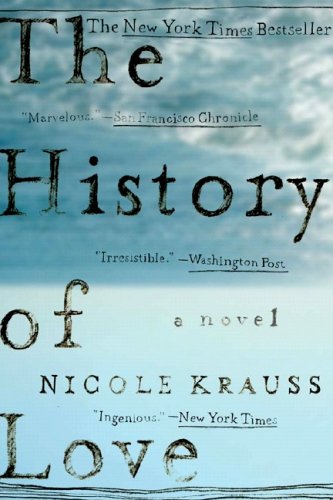
This sentence appeared in the June 21st issue of The New Yorker, in an article explaining the process of that magazine's selection of the twenty best writers under the age of 40. This may seem like a familiar mention, seeing that said list appeared, coincidentally, as I wrote about Wells Tower's Everything Ravaged, Everything Burned. After reading through that list, and catching up on some short stories written by some of those talented individuals, I wanted to read a novel by one of them, and I came across Nicole Krauss's The History Of Love. In the case, coincidence turned into intention, which then revealed itself as a pleasant mistake. A close friend of mine, with similar literary tastes, had been gushing over the fiction of Karen Russell, a woman who also appears on The New Yorker's list. Embarrassingly, I got the two names mixed up, and decided to read The History Of Love by Nicole Krauss, subliminally thinking that it was her, and not Karen Russell, whom my friend had recommended. However, after reading excerpts of Russell's work, it's obvious that both women are incredibly talented. In addition to being referred to as "genre-bending," I found that Krauss's 2005 novel was best described in terms of the magic in rules and conventions.

The History Of Love weaves together the tales of Alma Singer, a precocious teenager who's trying to explain to herself the death of her father, as well as her mother's blatant unhappiness. Her mother is translating a work (The History Of Love), and Alma ventures that the man who commissioned the translation may be a suitable match for her. Various family members are introduced, either in passing or with sizable parts, especially her brother, affectionately known as Bird, whose coping mechanisms eventually morph into a believe that he is a "lamed vovnik," a spiritual figure in the Jewish religion. Alma narrates her own parts of the novel, and Krauss does an admirable job of creating a teenage character who's equal parts regular teenager and wise beyond her years. Either character trait could easily have fallen into a sort of grandiose sketch, but, in keeping with the idea of "magical conventions," Alma is both heightened and realistic. She takes an interest in wilderness survival, since it was a passion of her father. This hobby is expressed both earnestly and with a tint of sadness, since the death of her father hovers over most of Alma's activities. However, it becomes a deft blend of obsessive list-making (a prevalent occurrence in the book), intelligence, and a realization of her still being a child.

"I kept Edible Plants and Flowers in North America under my bed in a backpack that also had my father's Swiss Army knife, a flashlight, a plastic tarp, a compass, a box of granola bars, two bags of peanut M&M's, three cans of tuna, a can opener, Band-Aids, a snakebite kit, a change of underwear, and a New York City map...
...For Chanukah I asked for a sleeping bag. The one my mother got me had pink hearts on it, was made of flannel, and would keep me alive for about five seconds in subzero temperatures before I died of hypothermia (Krauss 44-45)."


The other main character, and probably one of the most sympathetic characters in recent fiction, is an aging former writer and locksmith named Leo Gursky. He used to be in love in Poland before moving to America, and eventually lost the woman to unforeseen circumstances. This love led to the writing of a book that he long assumed had been lost, not to mention a son that grew up to become a writer, never knowing who his true biological father was. Leo's book makes its way to Chile, published under the name Zvi Litvinoff, and he eventually encounters his son at a book signing, both wishing to reach out to him, but also oddly comfortable in his usual invisible state. Leo occasionally draws attention to himself with mild accidents in public, and his every action is, at least subliminally, a way of coping with the loss of his former love. Again, much like the characterization of Alma (Alma and Leo are connected in much more profound ways), Leo is utterly convincing as a part of the novel. He's an aching combination of imminent death and past despair, without being the least bit melodramatic or overstated about his mindset. In this passage, he recalls watching his son.

"Every time Isaac moved, I mapped out the route between my place and his. The first time he was eleven. I used to stand across the street from his school in Brooklyn and wait for him, just to catch a glimpse, maybe, if I was lucky, hear the sound of his voice. One day I waited as usual, but he didn't come out. I thought maybe he'd gotten into trouble and had to stay late. It got dark, they turned off the lights, and still he didn't come. I went back the next day, and again I waited, and again he didn't come. That night I imagined the worst, I couldn't sleep, imagining all the awful things that might have happened to my child (Krauss 162)."

Given these introductions and sketches, two things should be clear. One, I'm obviously not doing the entire novel justice. At the heart of the book is a slight mystery, but one that should be semi-obvious, based on what I've written; it's even spelled out on the book's back cover synopsis. While the statute of limitations on a spoiler is long gone, part of The History Of Love's benefits are seeing the problems unfold. Two, someone unfamiliar with the book would be right in assuming, again based on my summaries, that it's one of the more depressing books written in recent years. Granted, large sections of the book are either saddening, or hinted with either symbolic or literal depression: Leo and Alma's mother are two perfect examples. Even the flashback scenes are glossed with references to the Holocaust.

"Even during the years when I hid in the forest, in trees, holes, and cellars, with death breathing down my neck, I still never thought about the truth: that I was going to die. Only after my heart attack, when the stones of the wall that separated me from childhood began to crumble at last, did the fear of death return to me. And it was just as frightening as it ever was (Krauss 129)."

However, and there's really no way to write this without being either cliched or making The History Of Love sound like a combination of a thousand other novels, in spite of the melancholy that permeates the characters, there's a definite sense of hope, at least in part because the reader can guess what the final outcome of the book will be. The fun, however, is the journey. Krauss's prose is extremely meticulous, but never borders on either mundane or careless. And, as she showed recently in her latest short story "The Young Painters," she can balance a straightforward narrative that also serves as its own mystery, in the sense of leaving the conclusion unforeseeable until the end. Her writing in this novel is an excellent mix, combining both contemporary settings and historical narratives, as well as sections that are composed exclusively as lists, and an ending broken up into careful parts, working as a stunning buildup to a satisfying, emotional ending. Much like the aforementioned Wells Tower, her plots sometimes take a backseat to structure, and while I feel it would be a stretch to call her experimental, she obviously knows what she's doing, and her voice is strong enough to break parts of the novel up aesthetically without having it be a distraction. The History Of Love is an excellent work, but, in the best of ways, I feel that her best writings are ahead of her. I feel that, despite the unanimous praise for this novel upon its publication, readers will look back at this one as a fine compliment to a more stunning bibliography.

Work Cited:
Krauss, Nicole. The History Of Love. Copyright 2005 by Nicole Krauss.

Friday, July 9, 2010

One Night Without the King


Last night, I took my dog for a walk, enjoying a rare July evening not weighed down with excessive humidity, a rarity in Chicago. After returning to my apartment, I made a light dinner and had a few hours' worth of conversation and beer with my older brother, who's visiting from Seattle. This all came after an easy day at work, and I don't think that too many people would disagree that the aforementioned activities were the ingredients of a nearly perfect summer night. However, the only real deviation came in the middle, when I excused myself to check ESPN.com, and found out that LeBron James had announced his intention to sign with the Miami Heat for the upcoming 2010-2011 NBA season. I watched a thirty second video clip of the moment of his announcement, and then got up from my desk to resume the more noble activities.

For the past week, I've unabashedly been a part of the herd, checking websites, reading about rumors, and keeping on top of all of the NBA free agents. Hell, I even found myself partaking in the ESPN page that was modeled after a slot machine, clicking the button to see the possible destinations of James, Dwyane Wade, Chris Bosh, Amare Stoudemire, and even David Lee. As you very well may know, I'm a Chicago Bulls fan, and I've spent the last week daydreaming about the possibility of James teaming up with Derrick Rose and Joakim Noah, adding scoring and an interior presence to a young, playoff-tested team. As the days went on, the possibility of James signing with the Bulls seemed less and less likely, but my enthusiasm didn't waver. In all likelihood, based on my personal hunches (not to mention way too many readings of every possible basketball writer available on the Web), I thought the likely choice would be for James to remain a Cleveland Cavalier. Of course, this didn't happen, but the fact that he chose the Heat is not the problem. The problem was his decision to announce this as a one-hour special entitled "The Decision."

And with that, the floodgates opened, and within the course of a day, he went from being one of the most well-liked athletes to one of the most despised (at least outside of South Florida). While I refused to watch the TV special, something was made painfully clear, but should be obvious--LeBron James is an entertainer above being a basketball player.

Of course, he's a phenomenally talented basketball player, if not the best living player right now. For all that the Cleveland franchise has done to bring in complimentary players, James hasn't played on a great team; he's only reached the NBA Finals once in his career. Like any player, he claims that his goal is to win championships, nothing more. And his signing with Miami proves that it's not about the money, since he could have earned $30 million more by signing with the Cavaliers. And it's very likely that the Heat will win at least one championship, if not more. The NBA's Eastern Conference is stronger, but still lacks the team depth of the Western Conference. If I were a coach or executive with the Heat, I'd be concerned about the team's chemistry. After re-signing guard Dwyane Wade and forward Chris Bosh, the Heat now have three players who are used to being the best on their former teams. One of those players isn't going to get the ball as much as he wants, which, if a championship is truly the goal, shouldn't be that big of an issue. However, the Heat are now like an exaggerated fantasy team. Someone's numbers are going to dip, and time will tell if that leads to any friction during a long season.

My decision (no pun intended) to not watch James' TV special was due to the fact that the off-season free agent parade had become a show in its own right, rather than a true look at how a given player could make a new team even better. The day before, the Bulls signed forward Carlos Boozer. In any other off-season, this would have been phenomenal news, since Boozer gives the Bulls some much-needed inside presence to compliment Noah, and his playoff numbers are seriously higher than his regular season totals. However, this signing took a backseat to "LeBron Watch," and it was then that I decided to save my energies for actually watching the games when the new season begins.

In watching the brief clip of James, the notion that he's an entertainer was never in doubt. He says everything that anyone would expect him to say, and the segment with Jim Gray comes across like every pre- or post-game interview given by any basketball player. James is a consummate professional, and as he rightfully states, the country (not just Ohio) has seen him grow from "an 18-year old kid to a 25-year old man."


The media will continue to feed on this for several weeks, and by even posting any thoughts about this, I've voluntarily included my voice in the millions that have shot opinions back and forth. However, I reached my limit and decided to extend my energies last night to more satisfying activities. And when I do resume focusing on this year's NBA season, I will give more attention to more worthy, and less expected story lines. The Bulls are a much better team with Carlos Boozer, and the Oklahoma City Thunder have wisely locked up star Kevin Durant to a long-term contract. But more importantly, the Heat won't be the only story. The younger, hungrier teams will be waiting once the season kicks off in October.

Wednesday, June 30, 2010

A Plurality Of Languages


It should go without saying that international literature is enjoying one of its strongest periods, and looks to continue that way in the coming years. While a lot of my essays in this realm tend to be heavy on Roberto Bolano, I'm hoping to add more diversity to my readings (however, there will be more Bolano reviews and essays coming). Elsewhere, one could point to Haruki Murakami's steady place in both critical circles and mainstream bestseller lists. The books published by Europa have a wonderful variety of titles available, most notably the bestseller The Elegance Of the Hedgehog, which, as a bookseller in the past year, I've noticed has not waned in reader enthusiasm. Most of us are introduced to international literature in high school, and it's safe to assume that works like Crime and Punishment or The Stranger were on your high school syllabus. This may seem like a basic introduction, but it's necessary as I begin to discuss a lesser known title, but one that's one of the best, early examples of a Western translation. Soseki Natsume's I Am a Cat had been on my reading list for quite some time. In addition to being a work that radically goes against most generalized notions of international fiction, the work also brought up many issues in my mind, most notably the idea of the potential limitations in certain translations.

I Am a Cat was originally intended to be a short story, but was expanded by Soseki into an epic, three-volume novel that was completed in 1906. The nameless narrator is a kitten who's wise from day one, and serves as the ultimate critic on human nature. He stumbles into living with Mr. Sneaze, a Japanese schoolteacher and henpecked, unhappy family man. In this living situation, the cat is able to see the comings and goings of a peculiar cast of characters, namely Mr. Waverhouse (who provides a bulk of the comic relief) and Mr. Coldmoon (an intellectual given to long pronouncements and rambling educational monologues). While the cat ages, his mentality never dims nor grows, although when interacting with other neighborhood cats, his preference of engaging in more human mentalities makes him "less" of a cat in some fashions. With the exception of a late-night burglary in Sneaze's home, none of the actions in the novel are particularly climactic. The activities of the people are what one would expect in everyday life, but the cat's narration highlights both his feline makeup and distance from human nature. His personality ranges from hilariously astute....

"To say that I 'sneak in' gives a misleading impression: it sounds vaguely reprehensible, a term to be used for the self-insinuations of thieves and clandestine lovers. Though it is true that I am not an invited guest, I do not go to the Goldfields' in order to snitch a slice of bonito or for a cozy chat with that disgusting lapdog whose eyes and nose are convulsively agglomerated in the center of its face. Hardly! Or are you suggesting that I visit there for the sheer love of snooping? Me, a detective? You must be out of your mind (Soseki 119)!"

...to very somber and thoughtful:

"Now the cat is a social animal and, as such, however highly he may rate his own true worth, he must contrive to remain, at least to some extent, in harmony with society as a whole. It is indeed a matter for regret that my master and his wife...do not treat me with that degree of respect which I properly deserve, but nothing can be done about it. That's the way things are, and it would be very much worse, indeed fatal, if in their ignorance they went so far as to kill me, flay me, serve up my butchered flesh at Tatara's dinner table, and sell my emptied skin to a maker of cat-banjos (Soseki 178)."


What was the most notable to me in my reading was the realism and modern tendencies in Soseki's writing style. Granted, having a house cat narrate a novel lends itself to notions of fantasy, but for the most part, the reader becomes comfortable with this notion, especially given the cat's eye for detail, plus the fact that he himself sees nothing out of the ordinary with his ability to see human beings on their own level. That's not to say that a little more fantasy would have helped. Once the novel gets going, it ranges from brilliant observations to semi-tedious pages upon pages of dialogue that seems to not move the story along. The discussions between the humans, most notable the back-and-forths between Sneaze, Coldmoon, and Waverhouse have stretches of philosophical ideas, humor, and an obvious dedication by Soseki for writing dialogue that reads very naturally. Virtually all of the conversations between Sneaze and his wife are arguments, but they're written carefully, highlighting the simmering tension and unhappiness between the two. Some of their conversations read like a stage play dialogue, an uncomfortable banter that comes very close to an all-out argument.

"'But they say it's very good after eating starchy things. I think you should take some.' His wife wants him to take it.
'Starchy or not, the stuff's no good.' He remains stubborn.
'Really, you are a most capricious man,' the mistress mutters as though to herself.
'I'm not capricious, the medicine doesn't work.'
'But until the other day, you used to say that it worked very well and you used to take it every day, didn't you?'
'Yes, it did work until the other day, but it hasn't worked since then,' an antithetical answer.
'If you continue in these inconsistencies, taking it one day and stopping it the next, however efficacious the medicine may be, it will never do you any good.'
'......I don't care. I don't take it because I don't take it. How can a mere woman understand such things? Keep quiet (Soseki 24-25).'"

I Am a Cat was translated by Aiko Ito and Graeme Wilson, and the time in which the novel was written, combined with losses given in any translation, gives the novel a decidedly non-Japanese feel. The novel comes from Japan's Meiji period, a time in which Japan began to open up to international relations (despite its inconsistencies, the Wikipedia page on this era provides some excellent, more detailed information). Soseki also studied in London, giving another side to understanding the Western "feel" to his novel. As with any major transformation, there was undoubtedly some tension between Soseki and Western culture, and that presents itself in I Am a Cat. The characters have their own problems, and it doesn't help when they're engaging in activities that try to strike a balance between Japanese society and Western influences.

Translations are never perfect. Translators should work to provide the most honest translations, but native and linguistic differences can make this impossible, especially considering the idiomatic differences between English and Japanese. As I've mentioned before, it's wonderful to have such a vast bibliography of translated works in English, but it's never the same as being able to read a work in its native language. This led me to seek some outside essays, and I garnered some excellent thoughts from a valuable collection called Theories of Translation. Some eloquent thoughts from Octavio Paz, in his essay entitled "Translation: Literature and Letters," highlights the sometimes treacherous balancing act that presents itself to even the best translators. This opening of the passage below is slightly, uncomfortably xenophobic, but moves into more thoughtful prose.

"The sounds of a tongue we do not know may cause us to react with astonishment, annoyance, indignation, or amused perplexity, but these sensations are soon replaced by uncertainties about our own language. We become aware that language is not universal; rather, there is a plurality of languages, each one alien and unintelligible to others. In the past, translations dispelled the uncertainties. Although language is not universal, languages nevertheless form part of a universal society in which, once some difficulties have been overcome, all people can communicate with and understand each other."--Octavio Paz

While I admire I Am a Cat as a piece of historical, international fiction, I'd be hard pressed to count it as a favorite. For all of the insights into human nature, as well as the relationship between two vastly different cultures, I found some stretches to be too inconsequential. While Soseki has to be saluted for his attention to detail, most of the chapters work much better as short stories, a fact that is acknowledged in my edition's introduction. However, Soseki's natural humor works wonders, giving the novel a comic, satirical side that is evident over one hundred years later. Despite my personal critiques, that is a sign of a novel that can be deemed a "classic." Some classics are wonderful historical sketches, and some are written in fashions that make certain texts continually relevant. Soseki provides both, even in a work that isn't perfect. In the aforementioned anthology of translation essays, I came across a passage by a Mexican writer named Jose Ortega y Gasset. The passage comes from a recap of a colloquium on translations, but inadvertently serves as a perfect introduction to Soseki's novel, almost good enough to work as a summary to the novel's themes. This may be excessively pessimistic, but also provides a wonderful highlight into translations and literary criticisms at their best. How else could an essay from a Mexican writer in 1937 so amazingly highlight a Japanese novel from 1906?

"Animals are normally happy. [Humans] have been endowed with an opposite nature. Always melancholic, frantic, manic, men are ill-nurtured by all those illnesses Hippocrates called divine. And the reason for this is that human tasks are unrealizable. The destiny of Man--his privilege and honor--is never to achieve what he proposes, and to remain merely an intention, a living utopia. He is always marching toward failure, and even before entering the fray he already carries a wound in his temple."

Work Cited:
Soseki Natsume. I Am a Cat. Copyright and translation 2002 by Aiko Ito and Graeme Wilson.

Thursday, June 24, 2010

American Wilds


Many decades have passed, many arguments have ensued, and many pieces have been written about what constitutes an American style or literary genre. Of course, there are thousands of American writers, some who write about the national landscape or social issues, and the combination of hypotheses, sequences, and definitions are/could be staggering in scope. Even an idea as wonderfully vague as the "Great American Novel" has been posed and dismissed just as often. Of course, the widespread popularity of international literature and foreign-born American writers adds yet another dimension to this idea, not that I've posed a specific idea anyway. To offer a simple idea, great writing is great writing, no matter what place a given writer calls home. However, as I read Wells Tower's short story collection Everything Ravaged, Everything Burned, I couldn't help but mentally classify him as an American writer. His stories span various settings, most of which are unspecified, whether urban or rural (with the exception of the title story, which takes place in a European Viking setting). There are no politics at play, but his characters and emotions, while universal, seem to fit perfectly into American sociology, for better or for worse.

I scribbled down Wells Tower's name in my notebook after reading a brief but unequivocally applauding review of his stories in Esquire magazine. He's been published numerous times before in some of the world's best literary magazines, but Everything Ravaged, Everything Burned has truly put him in the mainstream spotlight. During my reading, he was named by The New Yorker as one of the best writers under the age of 40. Such hype, especially lumped together in this paragraph, can seem excessive, but as a follower and lover of the short story genre, I'm pleased to note that his accolades are well-deserved. This collection is a careful combination of stunning descriptions and, depending on your personal disposition, some of the most sympathetic or reviled characters that I've come across in some time.

The prototypical protagonist in a Tower story (based on this book) is a male in crisis or at some sort of personal crossroad, sometimes both. Yes, literature is dominated by plays on masculinity, but Tower is careful to make them less obvious, and often with surprising habits. In "The Brown Coast," Bob resorts to filling an old aquarium with various forms of sea creatures as a way to cope with his infidelity and collapsing marriage. It's the sort of act that could go in one of two directions: it could become an obsessive way of coping, or a possible redemptive activity.

"The fish swam in contented circles and did not seem to mind the tiny white crabs that had come in with the seawater. The seams were sweating a little, and Bob patched them as best he could with caulk he found under the sink. Then he hiked over to the grocery store and bought two kinds of fish food. He carried it back, and sprinkled a little pinch of each food into the tank to see which one the fish preferred (Tower 14)."

Tower does create strong female characters, even if they're regulated to supporting roles. "Wild America" tells the story of two female teenage cousins, one beautiful, one not as much. This very scenario, with a less talented writer, could have easily become a mess of stereotyping and cliche, but here, it's handled with realistic depictions. Teenage bickering and togetherness coexist quite well throughout the course of the story, along with a consistent balance of humor.

"On the walk up Smithfield Road, Maya did not talk of Nureyev, or modeling, or of her own greatness. Instead, she boasted of Jacey's triumphs, her singing voice, and her speed in the fifty-yard dash (Jacey had the surprising fleet-footedness you sometimes find in the plump); how at the girls' camp of their childhood, Jacey had outfoxed a group of Methodists who'd beaten the cousins to the signup sheet for canoes by reminding them that at Judgment the last would be first, and that the meek would inherit the earth (Tower 167)."


The beauty of Tower's stories is that the plots, while intriguing, are often left open-ended or blatantly unresolved, resulting in atmospheres that somewhat evoke a more humorous Raymond Carver. At times, I found myself immersed in the intricacies of his eye for detail, and the applications of the classic writing rule of showing, not telling.

"Your mother's fingers graze your sternum, and this makes you uncomfortable. A spray of large and painful pimples has recently sprouted there. They throb with humiliated awareness when your mother touches them. This area of your body is a source of worry, in part because, years ago, a babysitter told you that in their teenage years all boys develop a soft spot in their chests, like a baby's fontanel, and that you could kill somebody by punching him in that place (Tower 115)."

These details make even the weaker stories contain some worth. "The Door In Your Eye" appears to be a sort of homage to Alfred Hitchcock's Rear Window, but dissolves into an unsatisfying climax that seems to be grasping for obvious symbolism. But as I mentioned, even the shaky plot of the story is lifted by the nuances of the characters, and the unique descriptions that make even the mundane feel heightened. The title story, "Everything Ravaged, Everything Burned," could be the most polarizing piece in the entire book. It's an old-fashioned Viking tale, but laced with modern dialogue for a story that feels both historical and relevant, with the dialogue working as bitingly funny in the face of intense violence (imagine what could be meant by the phrase 'blood eagle,' and see if the actual definition matches what you mentally created). When discussing various forms of art and creativity with friends, I often use the phrase "I love this, but I could see how others could hate it." "Everything Ravaged, Everything Burned" is a great example, since I can imagine that a comedy based on murderous Vikings wouldn't appeal to everyone.

"'Uh-huh, said Djarf. 'Can't tell us anything about a hailstorm, or locusts and shit, or a bunch of damn dragons coming around and scaring the piss out of everybody's wife. You don't know nothing about any of that.'
Naddod held his palms up and smiled piteously. 'No, I'm very sorry, I don't. We did send a monkey pox down to the Spanish garrison at Much Wenlock, but honestly, nothing your way.'
Djarf's tone changed, and his voice got loud and amiable. 'Huh. Well, that's something.' He turned to us and held up his hands. 'Hey, boys, hate to break it to you, but it sounds like somebody fucked something up here (Tower 227).'"

There are quite a few other stories that I haven't mentioned, but the examples above, while taken out of a lot of context, stand well as previews of Tower's writing style. The sociological aspects that I mentioned above are mainly in the sense that the characters are all seeking happiness in some capacity, but as in real life, it doesn't come as expected, doesn't come at all, or comes in profoundly disturbing ways. Tower's descriptive gifts alone are worth the attention, and combined with the wealth of emotions that the stories contain, the collection is one of the better books that I've read so far this year. Everything Ravaged, Everything Burned is an example of classic storytelling with unique twists, told by a writer who is rightfully on his way to the attention that he deserves.

Work Cited:
Tower, Wells. Everything Ravaged, Everything Burned. Copyright 2009 by Wells Tower.

For more on Wells Tower and his creative process, read this interview from Bookslut. Some of this conversation is standard, but Tower does highlight some excellent companion ideas to his stories and creations.

Sunday, June 20, 2010

"Likes/Dislikes:" Interactivities


(SPOILERS)
Anyone familiar with Facebook has surely come across online campaigns by Facebook users, demanding the addition of a "dislike" button to go along with the "like" feature. Supposedly, this is done a.) to show disapproval for bad news and to make sure that other Facebook users understand that news such as a broken leg or a crashed computer is nothing to be liked, and b.) because some people waste too much time on said website (I'll cast the first stone at myself). Perhaps it's saddening that such a widespread social media diversion was the first thing that popped into my head upon reading about Blank Line Collective's latest installment, "Likes/Dislikes." One final word about Facebook before I get into the more relevant thoughts: at best, the website can foster quick, yet inventive collaborations, with long-running commentaries and notes sometimes leading to a wonderful exchange of ideas. "Likes/Dislikes" is the epitome of collaborative creation, from its theatrical interpretation to its happenstance origins.

Amanda Lucas and Erica Barnes (the actresses in "Likes/Dislikes") found themselves looking through the zine collections housed by Chicago Underground Library, and stumbled upon a zine called "Likes/Dislikes" by Lacey Prpić Hedtke, an artist/writer based in Minnesota. The subject is a massive collection of simple statements, all beginning with either "she likes" or "she dislikes." There are hundreds of such phrases in the zine, and it's refreshing to find that, after a recent Google search, none of Hedtke's zine work is immediately available, given the creative intent of zines, normally available for modest payments or creative exchanges. Chicago Underground Library (an organization that I'm still planning on being involved with, even though I wrote that several months ago) rarely, if ever, turns down any submissions to their ever-growing database, thus explaining how a tiny, self-created work was in their possession in the first place. Blank Line decided to adapt the work into their latest piece, and the result is a quick, almost avant-garde performance, and a small link in a much larger piece.


The audience is led into the performance space by The Expert (Stephanie Brown), and immediately thrust into a white space completely covered with ink, pastel marks, mirrors, and paintings, with Lucas and Barnes writing, shouting, and sharing various ideas in the vein of "likes/dislikes." There is no seating, and the audience has complete control of where they view the performance, if at all; there's nothing stopping anyone from exploring the art on the walls and just listening to the ideas being exchanged in the background. Furthering the idea of links and collaborations, the audience is part of the creation, functioning as a sort of background to the ongoing movements. The "likes/dislikes" are often hilariously funny, but tinted with some sadness, despondency, anger, and subtle hopes that the various declarations won't be met with jeers or disbelief. Lucas and Barnes work their physical and emotive energies quickly, their "characters" (possible metaphors for the right and left sides of the brain) rarely stopping for any reflection or insinuations to sink in; ideas are tossed about, sometimes with some breathing room, but more often than not written down and discarded for the next round of ideas. The performance was very evocative of the Blank Line production of Eugene Ionesco's The New Tenant, heavy on the action and letting the implications stand on their own.

The beauty of the audience interaction continued on Saturday with a group discussion of the meanings behind "Likes/Dislikes." Questions, complaints and discussions were welcome, and to me, was still a part of the original performance. Every aspect of "Likes/Dislikes" is based on shared creativity, and the decision by Lucas, Barnes, and Brown to open up the floor to the audience was a wonderful combination of shared artistic intent and personal meanings garnered by the people in attendance. Zines are meant to be shared, Chicago Underground Library is meant to be a physical and mental colloquium, and "Likes/Dislikes" is merely an extension of those missions. The performance may lead to some initial confusion and questions, but in reality, that's the whole point.

NOTE: "Likes/Dislikes" has two more performances scheduled:
June 25th and June 26th, 8:00PM
Fulton Street Collective, 2000 W. Fulton Street, Chicago, IL 60612.
Suggested Donation: $10-15, with a silent auction of stage materials beforehand. Click here for more information.

(Blank Line photograph taken by Nk Mooneyham)

2021 Readings, 2022 Goals

In keeping with the 2020 trend, my reading total was pretty sad, as you can tell.  As always, it's about quality, not quantity, but sure...