Last month, in an attempt to brush up on philosophy texts that have flown under my radar, I read Martin Heidegger's Poetry Language Thought. I remembered that his other works were touched upon briefly in some of my college courses, and recent research on him brought up something that I had totally forgotten about--his link to Nazism. I don't know the full history of his relationship to that ideology (save for some very generic bullet points), I do know that some of his supporters attempted to soften the blow of such a connection. There are two very distinct points of view at play here: one side will say that in Europe during World War II, the choice was very clear, that one could choose to superficially "accept" Nazism or lose their well-being (or life) otherwise. The other side will say that any acceptance equals guilt, regardless of whether or not a person was trying to save his or her own life. My point is that Heidegger wrote some of the most influential philosophy texts in history, yet will always be linked to one of the most horrendous "philosophies" in history as well. It's a staggering dynamic--how can an outside observer balance someone's contributions along with someone's evils, especially with something as evil as Nazism? This being said, had Heidegger been a fictional character, he very well would have been one of the many composites in Roberto Bolano's Nazi Literature In the Americas (first published in English in 2008).
I went into reading this Bolano text trying to be as impartial as possible, given the fact that I was still feeling the amazing awe of The Savage Detectives. Nazi Literature In the Americas is a vastly different work, both in themes and length. Instead of providing us with hundreds of pages devoted to exploring the lives of imaginary, generally admirable (though faulted) writers, Bolano writes very brief biographical sketches of writers from North, Central, and South America, all of whom (explicitly or not) are connected to Nazism or Nazi sympathies. While these are fictionalized descriptions, readers cannot help but get caught up in Bolano's attention to detail, describing, in precise detail, the writers and lifestyles of these artists. In the same sense of The Savage Detectives, I found myself admiring the prodigious outputs and hedonistic tendencies, since the idea of Nazism is not pointed out on every page. At times, it came as a suckerpunch, nodding along with the lifestyles, only to be reminded of the sometimes latent theme of evil. This is where my introduction on Heidegger comes into view--the writers in Nazi Literature In the Americas are brilliant, yet the idea is that a seriously faulted ideology is lurking below the surface.
Bolano also employs the "dust-fucker" style of comparisons (for the origins and explanations of this term, click here). Again, as evil as Nazism is, some of the writers in the novel are more extreme than others--in short, Bolano has characters who are even worse Nazis than others. Take these passages, for example:
"The failure of her marriage plunged Luz into despair. She took to drinking in dives and having affairs with some of the most unsavory individuals in Buenos Aires. Her well-known poem "I Was Happy With Hitler," misunderstood by the Right and the Left alike, dates from this period (21)."
"...[Borda's] mere existence, in short, brought out the basest, most deeply hidden instincts in the people whose paths he crossed, for one reason or another, in the course of his life. There is, however, no evidence to suggest that any of this demoralized him. In his Diaries he blames the Jews and usurers for everything (109)."
In the hands of a lesser writer, a book such as this could have merely turned into a catalogue of depraved individuals. With Bolano, the degrees of repulsion are almost scientific. As with the two cited examples above, a reader acknowledges that the two fictional writers have ideological faults, but have to acknowledge that the writing of a poem is a "lesser evil" than a blatant written hatred of an entire people.
At the end of the novel, Bolano stunningly crafted a detailed bibliography of the writers, including ones not described in the book. In addition to admiring the minute detail, I was taken aback by the bibliography's title: "Epilogue For Monsters." With three words, any earlier rationalization is thrown away, since every party is guilty. The effect is very similar to the final line of James Wright's poem Lying In a Hammock On William Duffy's Farm In Pine Island, Minnesota: "I have wasted my life." Everything that comes before it, while essential, is overtaken by a single line. This literary skill, especially compared with the vastness of The Savage Detectives, reaffirms my belief that Bolano is one of most important writers of the past twenty years. I cannot wait to take on his final work, 2666.
Work Cited:
Bolano, Roberto. Nazi Literature In the Americas. Copyright 2008 by the Heirs of Roberto Bolano. Translation copyright 2008 by Chris Andrews.
Sunday, December 7, 2008

Wednesday, December 3, 2008
50th Post: Odds and Ends
I'm a little behind on some of this month's essays, so I thought I'd have some relaxed fun with this post. I'm pleased to note that this is my fiftieth post on Chicago Ex-Patriate, and since I don't see myself commemorating every "milestone" post, this should be a one-and-done affair. However, I already have a plan for this blog's one year anniversary in February, but that is down the line. Also, on a personal note, I'm very pleased with how my writings and contributions are taking shape. I'm still not as "quality consistent" as I'd like to be, but when I started this blog, I simply had no idea where it would be going, content-wise. Thanks to everyone for their readings, comments, and support. My network here is small, but I'm grateful for the impressive writers and bloggers who support this project. The new year will hopefully bring more maturation and variety to my writings.
I don't remember where, but someone once linked an article listing the signs of a bad blog. One of the signs was the inclusion of lists: best ofs, top tens, and so forth. However, some of the blogs that I regularly read have posted these kinds of lists, and the quality was just fine. So, in keeping with the idea of "fifty," I'm attempting a combined list of my "Fifty Essentials," whether they be books, albums, or films. I hesitate to call these my favorites, since that list always fluctuates. However, these are fifty titles that I feel have shaped and influenced me to this point. Enjoy.
1.) Le Samourai by John-Pierre Melville (film)
2.) How To Be Alone by Jonathan Franzen (book)
3.) In the Wee Small Hours by Frank Sinatra (album)
4.) No Country For Old Men by Joel and Ethan Coen (film)
5.) The Great Shark Hunt by Hunter S. Thompson (book)
6.) Yankee Hotel Foxtrot by Wilco (album)
7.) Jackie Brown by Quentin Tarantino (film)
8.) The Savage Detectives by Roberto Bolano (book)
9.) Hail To the Thief by Radiohead (album)
10.) Goodfellas by Martin Scorsese (film)
11.) The Rush For Second Place by William Gaddis (book)
12.) Kind of Blue by Miles Davis (album)
13.) Glengarry Glen Ross by James Foley (film)
14.) The Fortress Of Solitude by Jonathan Lethem (book)
15.) Picaresque by the Decemberists (album)
16.) Amelie by Jean-Pierre Jeunet (film)
17.) Choke by Chuck Palahniuk (book)
18.) Animals by Pink Floyd (album)
19.) The General by Clyde Bruckman and Buster Keaton (film)
20.) The Middle Mind by Curtis White (book)
21.) Z by My Morning Jacket (album)
22.) From Here to Eternity by Fred Zinnemann (film)
23.) White Noise by Don DeLillo (book)
24.) Abbey Road by the Beatles (album)
25.) The Big Sleep by Howard Hawks (film)
26.) The Road by Cormac McCarthy (book)
27.) Give Up by the Postal Service (album)
28.) Nosferatu by F. W. Murnau (film)
29.) Sex, Drugs, and Cocoa Puffs by Chuck Klosterman (book)
30.) Come On Feel the Illinoise! by Sufjan Stevens (album)
31.) Le Cercle Rouge by Jean-Pierre Melville (film)
32.) Brief Interviews With Hideous Men by David Foster Wallace (book)
33.) Highway 61 Revisited by Bob Dylan (album)
34.) Rashomon by Akira Kurosawa (film)
35.) Wise Blood by Flannery O'Connor (book)
36.) 13 Songs by Fugazi (album)
37.) The Lives Of Others by Florian Henckel von Donnersmarck (film)
38.) Bloodcurdling Tales Of Horror and the Macabre by H.P. Lovecraft (book)
39.) Blacklisted by Neko Case (album)
40.) Fear and Loathing In Las Vegas by Terry Gilliam (film)
41.) Bambi Vs. Godzilla by David Mamet (book)
42.) The Mysterious Production Of Eggs by Andrew Bird (album)
43.) All the Real Girls by David Gordon Green (film)
44.) Dubliners by James Joyce (book)
45.) Class Clown by George Carlin (album)
46.) Dog Day Afternoon by Sidney Lumet (film)
47.) White Teeth by Zadie Smith (book)
48.) The End Of Love by Clem Snide (album)
49.) Cat On a Hot Tin Roof by Richard Brooks (film)
50.) A Supposedly Fun Thing I'll Never Do Again by David Foster Wallace (book)
On a final note, I normally have a seething hatred for music videos which are literal interpretations of the given song, whether these videos involve the band or are made by a random student filmmaker and posted on YouTube. However, I stumbled across this video for the Decemberists' O Valencia! and was quite pleased. Yes, it's a literal interpretation, but I found it amazingly enjoyable. Perhaps this is due to the cinematography or the dark humor, or possibly both:
I don't remember where, but someone once linked an article listing the signs of a bad blog. One of the signs was the inclusion of lists: best ofs, top tens, and so forth. However, some of the blogs that I regularly read have posted these kinds of lists, and the quality was just fine. So, in keeping with the idea of "fifty," I'm attempting a combined list of my "Fifty Essentials," whether they be books, albums, or films. I hesitate to call these my favorites, since that list always fluctuates. However, these are fifty titles that I feel have shaped and influenced me to this point. Enjoy.
1.) Le Samourai by John-Pierre Melville (film)
2.) How To Be Alone by Jonathan Franzen (book)
3.) In the Wee Small Hours by Frank Sinatra (album)
4.) No Country For Old Men by Joel and Ethan Coen (film)
5.) The Great Shark Hunt by Hunter S. Thompson (book)
6.) Yankee Hotel Foxtrot by Wilco (album)
7.) Jackie Brown by Quentin Tarantino (film)
8.) The Savage Detectives by Roberto Bolano (book)
9.) Hail To the Thief by Radiohead (album)
10.) Goodfellas by Martin Scorsese (film)
11.) The Rush For Second Place by William Gaddis (book)
12.) Kind of Blue by Miles Davis (album)
13.) Glengarry Glen Ross by James Foley (film)
14.) The Fortress Of Solitude by Jonathan Lethem (book)
15.) Picaresque by the Decemberists (album)
16.) Amelie by Jean-Pierre Jeunet (film)
17.) Choke by Chuck Palahniuk (book)
18.) Animals by Pink Floyd (album)
19.) The General by Clyde Bruckman and Buster Keaton (film)
20.) The Middle Mind by Curtis White (book)
21.) Z by My Morning Jacket (album)
22.) From Here to Eternity by Fred Zinnemann (film)
23.) White Noise by Don DeLillo (book)
24.) Abbey Road by the Beatles (album)
25.) The Big Sleep by Howard Hawks (film)
26.) The Road by Cormac McCarthy (book)
27.) Give Up by the Postal Service (album)
28.) Nosferatu by F. W. Murnau (film)
29.) Sex, Drugs, and Cocoa Puffs by Chuck Klosterman (book)
30.) Come On Feel the Illinoise! by Sufjan Stevens (album)
31.) Le Cercle Rouge by Jean-Pierre Melville (film)
32.) Brief Interviews With Hideous Men by David Foster Wallace (book)
33.) Highway 61 Revisited by Bob Dylan (album)
34.) Rashomon by Akira Kurosawa (film)
35.) Wise Blood by Flannery O'Connor (book)
36.) 13 Songs by Fugazi (album)
37.) The Lives Of Others by Florian Henckel von Donnersmarck (film)
38.) Bloodcurdling Tales Of Horror and the Macabre by H.P. Lovecraft (book)
39.) Blacklisted by Neko Case (album)
40.) Fear and Loathing In Las Vegas by Terry Gilliam (film)
41.) Bambi Vs. Godzilla by David Mamet (book)
42.) The Mysterious Production Of Eggs by Andrew Bird (album)
43.) All the Real Girls by David Gordon Green (film)
44.) Dubliners by James Joyce (book)
45.) Class Clown by George Carlin (album)
46.) Dog Day Afternoon by Sidney Lumet (film)
47.) White Teeth by Zadie Smith (book)
48.) The End Of Love by Clem Snide (album)
49.) Cat On a Hot Tin Roof by Richard Brooks (film)
50.) A Supposedly Fun Thing I'll Never Do Again by David Foster Wallace (book)
On a final note, I normally have a seething hatred for music videos which are literal interpretations of the given song, whether these videos involve the band or are made by a random student filmmaker and posted on YouTube. However, I stumbled across this video for the Decemberists' O Valencia! and was quite pleased. Yes, it's a literal interpretation, but I found it amazingly enjoyable. Perhaps this is due to the cinematography or the dark humor, or possibly both:
Friday, November 28, 2008
Casual Friday--Poetry V
On and off for at least three years, I continually pick up and skim through Picnic, Lightning by Billy Collins. I don't know that much about his history, other than his previous tenure as the U.S. Poet Laureate and his set place as one of America's most respected poets. While I plan to do more research on him and other poets (both established and independent), for now, I feel that it's to my benefit to not know much about his accepted, defined style or to have instant comparisons to his previous poetry collections. I only purchased Picnic, Lightning in order to do a presentation some years back in an introductory poetry class. As I read some selections this week, I feel that I picked up on what could be considered his "style," as varied as that definition can be, especially in relation to poetry.
The poem that jumped out at me is entitled "After the Storm," a look at a house in the early morning, following a late-night dinner party. I'm not going to transcribe the entire piece, but I want to look at some select stanzas in relation to my understanding of his aesthetics. The first stanza is simple, with simple metaphors that render their descriptions in an utterly perfect manner:
The poem that jumped out at me is entitled "After the Storm," a look at a house in the early morning, following a late-night dinner party. I'm not going to transcribe the entire piece, but I want to look at some select stanzas in relation to my understanding of his aesthetics. The first stanza is simple, with simple metaphors that render their descriptions in an utterly perfect manner:
"Soft yellow-gray light of early morning,
butter and wool,
the two bedroom windows
still beaded and streaked with rain (41)."
I re-read the second line over and over, each time more amazed at how perfect the description is in relation to the first line. Butter and wool. Yellow and gray. Soft and slightly abrasive. Again, I use the word "simple," but it is in no way an insult to Collins's craft. Instead of going for a slightly more obscure reference, he opts for descriptions that trigger the senses. As I'm always ready to remind people during my poetry posts, I'm trying to build up my knowledge of poetic craft, and it's a testament to Collins's talent that what seem like easy metaphors at the beginning are actually untouchable.
"the long table, dark bottles of Merlot,
the odd duck and brussels sprouts,
and how, after midnight,
with all of us sprawled on the couch and floor (41),"
This is the fifth stanza, and to me, Collins is walking a delicate line. While the beauty of poetry is the ability to find poetic movements in everyday life, there's a slight risk of "boring" some readers with imagery of a pretty standard dinner party. However, the last line hints to the fifteenth stanza, which is familiar to everyone:
"even the ghosts of ourselves
had to break up the party,
snub out their cigarettes,
carry their wineglasses to the kitchen (43),"
Once again, Collins whips out the poetry of the mundane. The "ghosts of ourselves" reminded me of your typical hangover, even if this isn't what he intended to begin with--we all wake up after late nights with vague memories of dragging ourselves up, finishing the long nights, and engaging in late night tasks: emptying ashtrays, gathering up empty bottles, etc. Of course, I'm leaving out the main storyline of the poem--hints of a previous night's party reflecting themselves the following morning. And I'm probably committing a major sin by just focusing on three stanzas of a poem that consists of nearly twenty. However, what I wanted to show is that Collins can take what appears to be "basic poetry" and "simple events" and make them captivating.
Work Cited:
Collins, Billy. Picnic, Lightning. Copyright 1998 by Billy Collins.
Sunday, November 23, 2008
The Bleak Future Of Music
Yes, I understand that the title of this post can be a little misleading, since I'm not at all bemoaning the quality of music today (or in the near future). However, what does disappoint me is the realization that, as time goes on, there will be less and less opportunities to discover lost pieces of musical development/history, especially in this era of internet technology and, both in conjunction with that and to a lesser extent, bootlegging. Allow me to explain this with more clarity. I read a wonderful article in the November issue of Harper's entitled "Unknown Bards," written by John Jeremiah Johnson. In it, he recounts an early fact-checking mission to uncover the lyrics of a rare blues LP, enlisting the help of musician/blues intellectual John Fahey. Sullivan's sketch of Fahey makes him come across as eccentric, which I always assumed was a stereotype of blues collectors/historians (the images that come to my mind are Steve Buscemi's character in Ghost World and some selected album covers by R. Crumb). However, this is not far off, according to the article:
"'The serious blues people are less than ten...most are to one degree or another sociopathic (p. 89)."
The article combined solid historical information with a very compelling musical treasure hunt. After my reading, I felt that these kinds of activities and scavengings will lose prominence as my generation gets older. If need be, I could easily go online to find out-of-print recordings and unreleased live shows. Hm, I want to re-listen to a Jeff Tweedy solo show from 2006. Click, click, done. As March of 2009 nears, I'm sure I could do some illegal searching for a preview of Neko Case's new studio album, which will undoubtedly be leaked at some point, which seems to be the case with all albums. With these thoughts, I'm getting more into the subject of music piracy as opposed to my original thoughts. However, it's that kind of technology that is a blessing and a curse. With all the bands I admire today, there's virtually no chance that something will become "lost." On the other hand, it eliminates the possibility of "hunting" for future generations. Today, the concept of an album being out-of-print does not carry the same urgency and fear that it does for early blues recordings.
Then again, there still might be the opportunity for discovery in other ways. I can only imagine that some artists (Conor Oberst comes to mind) have cabinets full of unreleased home recordings, ones that might remain out of sight for years to come. To some extent, I'm sure there's a teenager somewhere recording songs on his or her computer, songs that are absolute genius, but will not be heard by mass audiences. But for the most part, the majority of music will always be available. Overall, this is wonderful, but the idea of tracking down a long-lost Colin Meloy demo in fifty years just strikes me as intriguing. Hopefully, despite recording advances, there will still be an intangible element of mystery.
"'The serious blues people are less than ten...most are to one degree or another sociopathic (p. 89)."
The article combined solid historical information with a very compelling musical treasure hunt. After my reading, I felt that these kinds of activities and scavengings will lose prominence as my generation gets older. If need be, I could easily go online to find out-of-print recordings and unreleased live shows. Hm, I want to re-listen to a Jeff Tweedy solo show from 2006. Click, click, done. As March of 2009 nears, I'm sure I could do some illegal searching for a preview of Neko Case's new studio album, which will undoubtedly be leaked at some point, which seems to be the case with all albums. With these thoughts, I'm getting more into the subject of music piracy as opposed to my original thoughts. However, it's that kind of technology that is a blessing and a curse. With all the bands I admire today, there's virtually no chance that something will become "lost." On the other hand, it eliminates the possibility of "hunting" for future generations. Today, the concept of an album being out-of-print does not carry the same urgency and fear that it does for early blues recordings.
Then again, there still might be the opportunity for discovery in other ways. I can only imagine that some artists (Conor Oberst comes to mind) have cabinets full of unreleased home recordings, ones that might remain out of sight for years to come. To some extent, I'm sure there's a teenager somewhere recording songs on his or her computer, songs that are absolute genius, but will not be heard by mass audiences. But for the most part, the majority of music will always be available. Overall, this is wonderful, but the idea of tracking down a long-lost Colin Meloy demo in fifty years just strikes me as intriguing. Hopefully, despite recording advances, there will still be an intangible element of mystery.
Tuesday, November 18, 2008
Solitary Pursuits
"At that moment the equation became clear to him: the act of writing as an act of memory. For the fact of the matter is, other than the poems themselves, he has not forgotten any of it (Auster 141)."
Forgive me if this essay is heavily tinted with autobiographical asides. One of the reasons I moved to the Seattle area this year was to focus on writing, to make up for the lack of attention that I had been paying. Naturally, I was homesick, which I dealt with by sending long e-mails to friends, happily detailing my newfound focus on writing, coupled with the fascination of exploring a new city, one that I had never even visited before. A friend of mine recommended Paul Auster's The Invention of Solitude, saying that I would relate to the look at the solitary nature of writing and creativity. After recently finishing the book (a few months after this recommendation), I was immediately reminded of a conversation with another friend of mine, one who found it curious (read: odd) that I enjoyed reading books about writing. I'm amazed at how right these two friends were, both the first one with his accurate recommendation, and the second one with her affirming question. I'll gladly be considered odd.
The Invention of Solitude is composed of two volumes in one. The first half ("Portrait Of An Invisible Man") consists of Auster writing about his father, a man of complex emotions, both infuriating and gently touching, and a man who dealt with a family tragedy which accounted for his makeup (an event that Auster found out about purely by chance). At first, I found this first half extremely compelling and well written, but I was anxiously awaiting the second half of the book for his insights on writing. However, he provided some passages that hit me in the stomach, passages undoubtedly relatable to young male writers and their relationships with their fathers. This is not at all a slight towards female writers, but one of the unspoken themes of this book is abstract masculinity.
"His most common description of me was that I had 'my head in the clouds,' or else that I 'did not have my feet on the ground.' Either way, I must not have seemed very substantial to him, as if I were somehow a vapor or a person not wholly of this world. In his eyes, you became part of the world by working. By definition, work was something that brought in the money. If it did not bring in money, it was not work. Writing, therefore, was not work, especially the writing of poetry. At best it was a hobby, a pleasant way to pass the time in between the things that really mattered. My father thought that I was squandering my gifts, refusing to grow up (61)."
To an extent, these words describe my relationship with my own father. I love him immensely, and he has always supported me, but while I was in college, he kept hinting that I should study business instead of writing. His feelings were totally well-intentioned, that after college I needed something to fall back on. Even to this day, I sometimes feel like I'm still trying to prove that I'm not merely engaging in a hobby, but working on what I really want to do.
The second half of the book is entitled "The Book Of Memory," a collection of fictionalized autobiographical memories, mixed together with personal examples of the solitary writer. This idea can easily be open to outside stereotypes: a disaffected young male, sitting alone in squalor, attempting to create art. While that might describe "A." (Auster's fictionalized version of himself), it's not at all a caricature, but rather personal history and honesty. "Memory is a room, as a body, as a skull, as a skull that encloses the room in which a body sits. As in the image: 'a man sat alone in his room' (86)." As brief as this quote is, this is the core of Auster's beginnings and growth as a writer, an idea that is truly universal among artists. Despite the revolving door of acceptance, publication, gallery shows, feedback, critiques, networks, and sharing of creative endeavors, virtually all art begins with a man or a woman alone in a room, engaging in creation. Even after the art has been exposed to the outside world, it will come back around to solitude:
"Every book is an image of solitude. It is a tangible object that one can pick up, put down, open and close, and its words represent many months, if not years, of one man's solitude, so that with each word one reads in a book one might say to himself that he is confronting a particle of that solitude (135)."
The quoted passage that opened this essay is crucial to the book, appropriately buried towards the end. While this might seem like an obvious idea, sometimes it is easy to forget that virtually all writing is affected by memories and experiences. This is not to say that all writing has to be autobiographical, nor am I falling on what I've always found to be a horrible piece of advice for beginning writers: "Write what you know." However, memories shape everything that we do. A given piece of writing may have no resemblance or bearing on the author's life, but his or her memories have shaped who they are and how they've come to creating what they have done.
To close, and for the final autobiographical allusion to myself, Auster has a phenomenal description of writers, yet another one that made me nod in agreement. This might have been more appropriate to write about a few months ago, when I first moved to Seattle, but I still sometimes see myself as a singular entity, both where I live and how I see myself as a writer:
"He has spent the greater part of his adult life walking through cities, many of them foreign. He has spent the greater part of his adult life hunched over a small rectangle of wood, concentrating on an even smaller rectangle of white paper. He has spent the greater part of his adult life standing up and sitting down and pacing back and forth. These are the limits of the known world. He listens. When he hears something, he begins to listen again. Then he waits. He watches and waits. And when he begins to see something, he watches and waits again. These are the limits of the known world (96)."
Work Cited:
Auster, Paul. The Invention of Solitude. Copyright 1982 by Paul Auster.
Forgive me if this essay is heavily tinted with autobiographical asides. One of the reasons I moved to the Seattle area this year was to focus on writing, to make up for the lack of attention that I had been paying. Naturally, I was homesick, which I dealt with by sending long e-mails to friends, happily detailing my newfound focus on writing, coupled with the fascination of exploring a new city, one that I had never even visited before. A friend of mine recommended Paul Auster's The Invention of Solitude, saying that I would relate to the look at the solitary nature of writing and creativity. After recently finishing the book (a few months after this recommendation), I was immediately reminded of a conversation with another friend of mine, one who found it curious (read: odd) that I enjoyed reading books about writing. I'm amazed at how right these two friends were, both the first one with his accurate recommendation, and the second one with her affirming question. I'll gladly be considered odd.
The Invention of Solitude is composed of two volumes in one. The first half ("Portrait Of An Invisible Man") consists of Auster writing about his father, a man of complex emotions, both infuriating and gently touching, and a man who dealt with a family tragedy which accounted for his makeup (an event that Auster found out about purely by chance). At first, I found this first half extremely compelling and well written, but I was anxiously awaiting the second half of the book for his insights on writing. However, he provided some passages that hit me in the stomach, passages undoubtedly relatable to young male writers and their relationships with their fathers. This is not at all a slight towards female writers, but one of the unspoken themes of this book is abstract masculinity.
"His most common description of me was that I had 'my head in the clouds,' or else that I 'did not have my feet on the ground.' Either way, I must not have seemed very substantial to him, as if I were somehow a vapor or a person not wholly of this world. In his eyes, you became part of the world by working. By definition, work was something that brought in the money. If it did not bring in money, it was not work. Writing, therefore, was not work, especially the writing of poetry. At best it was a hobby, a pleasant way to pass the time in between the things that really mattered. My father thought that I was squandering my gifts, refusing to grow up (61)."
To an extent, these words describe my relationship with my own father. I love him immensely, and he has always supported me, but while I was in college, he kept hinting that I should study business instead of writing. His feelings were totally well-intentioned, that after college I needed something to fall back on. Even to this day, I sometimes feel like I'm still trying to prove that I'm not merely engaging in a hobby, but working on what I really want to do.
The second half of the book is entitled "The Book Of Memory," a collection of fictionalized autobiographical memories, mixed together with personal examples of the solitary writer. This idea can easily be open to outside stereotypes: a disaffected young male, sitting alone in squalor, attempting to create art. While that might describe "A." (Auster's fictionalized version of himself), it's not at all a caricature, but rather personal history and honesty. "Memory is a room, as a body, as a skull, as a skull that encloses the room in which a body sits. As in the image: 'a man sat alone in his room' (86)." As brief as this quote is, this is the core of Auster's beginnings and growth as a writer, an idea that is truly universal among artists. Despite the revolving door of acceptance, publication, gallery shows, feedback, critiques, networks, and sharing of creative endeavors, virtually all art begins with a man or a woman alone in a room, engaging in creation. Even after the art has been exposed to the outside world, it will come back around to solitude:
"Every book is an image of solitude. It is a tangible object that one can pick up, put down, open and close, and its words represent many months, if not years, of one man's solitude, so that with each word one reads in a book one might say to himself that he is confronting a particle of that solitude (135)."
The quoted passage that opened this essay is crucial to the book, appropriately buried towards the end. While this might seem like an obvious idea, sometimes it is easy to forget that virtually all writing is affected by memories and experiences. This is not to say that all writing has to be autobiographical, nor am I falling on what I've always found to be a horrible piece of advice for beginning writers: "Write what you know." However, memories shape everything that we do. A given piece of writing may have no resemblance or bearing on the author's life, but his or her memories have shaped who they are and how they've come to creating what they have done.
To close, and for the final autobiographical allusion to myself, Auster has a phenomenal description of writers, yet another one that made me nod in agreement. This might have been more appropriate to write about a few months ago, when I first moved to Seattle, but I still sometimes see myself as a singular entity, both where I live and how I see myself as a writer:
"He has spent the greater part of his adult life walking through cities, many of them foreign. He has spent the greater part of his adult life hunched over a small rectangle of wood, concentrating on an even smaller rectangle of white paper. He has spent the greater part of his adult life standing up and sitting down and pacing back and forth. These are the limits of the known world. He listens. When he hears something, he begins to listen again. Then he waits. He watches and waits. And when he begins to see something, he watches and waits again. These are the limits of the known world (96)."
Work Cited:
Auster, Paul. The Invention of Solitude. Copyright 1982 by Paul Auster.
Thursday, November 13, 2008
An Early Christmas
"Don't you see that this is a fucking symbol?"
This line is spoken early in the film Christmas On Mars, the latest creation by the Flaming Lips (written, directed, and edited by frontman Wayne Coyne). At first, I thought the line was supposed to be tongue-in-cheek, since the viewer is exposed to a barrage of imagery just begging to be analyzed symbolically: light, outer space, birth/creation/female genitalia, death, and isolation, to name a few. In addition, these themes are presented in merely an hour and a half, although this running time feels much shorter. However, as I think about it after my first viewing, I realize that the line should be taken at face value...these are just symbols. Combined with the story, we're treated to a wonderfully structured science fiction yarn. I cannot tell yet if I merely enjoyed it a lot, or if it could be a work of artistic genius. Perhaps time will tell after future viewings.
The Flaming Lips have been working on this film for well over ten years, and its release on DVD has come quite suddenly. The story involves an American space station on Mars during Christmas Eve, awaiting the birth of the first human child in outer space. We meet alternatingly stern and hilarious characters through the eyes of Major Syrtis (Steven Drozd), who witnesses the death of one of his fellow crew members, and is moody and introspective even before more trying events happen. During various mishaps and hallucinations, a silent Alien Super-Being (Coyne) casually walks into the space station:
 At first glance, it's comical, but that's the whole point. The alien costume design and the black and white photography/cinematography are made to invoke 1950s space movies and television shows. By the end, astute viewers will catch references to The Day the Earth Stood Still, Solaris, 2001: A Space Odyssey, and probably a few others that I missed. I think I've covered the basic film details without giving too much away; this is truly a film that must be seen to be fully understood and appreciated. However, I think Coyne puts it best in the liner notes: "[This]...is just an elaborate, arty, home movie starring the band with our friends and family."
Another excellent part of the film is the soundtrack, which branches out into new territory for the Flaming Lips. One would think that a science-fiction movie would be perfect for their usual brand of psychedelia, but here they opt for an almost classical sound, mixed with drawn out atmospheres that evoke outer space just as well as the soundtrack for 2001 did many years back. Film scores can be very hit or miss when placed on their own, but the soundtrack for Christmas On Mars stands up very well. I'll leave you with some screencaps, ones that best represent the cinematography of the film. The photography for the film was done by Coyne's wife, J. Michelle-Martin Coyne, and she did an impressive job.
This line is spoken early in the film Christmas On Mars, the latest creation by the Flaming Lips (written, directed, and edited by frontman Wayne Coyne). At first, I thought the line was supposed to be tongue-in-cheek, since the viewer is exposed to a barrage of imagery just begging to be analyzed symbolically: light, outer space, birth/creation/female genitalia, death, and isolation, to name a few. In addition, these themes are presented in merely an hour and a half, although this running time feels much shorter. However, as I think about it after my first viewing, I realize that the line should be taken at face value...these are just symbols. Combined with the story, we're treated to a wonderfully structured science fiction yarn. I cannot tell yet if I merely enjoyed it a lot, or if it could be a work of artistic genius. Perhaps time will tell after future viewings.
The Flaming Lips have been working on this film for well over ten years, and its release on DVD has come quite suddenly. The story involves an American space station on Mars during Christmas Eve, awaiting the birth of the first human child in outer space. We meet alternatingly stern and hilarious characters through the eyes of Major Syrtis (Steven Drozd), who witnesses the death of one of his fellow crew members, and is moody and introspective even before more trying events happen. During various mishaps and hallucinations, a silent Alien Super-Being (Coyne) casually walks into the space station:
 At first glance, it's comical, but that's the whole point. The alien costume design and the black and white photography/cinematography are made to invoke 1950s space movies and television shows. By the end, astute viewers will catch references to The Day the Earth Stood Still, Solaris, 2001: A Space Odyssey, and probably a few others that I missed. I think I've covered the basic film details without giving too much away; this is truly a film that must be seen to be fully understood and appreciated. However, I think Coyne puts it best in the liner notes: "[This]...is just an elaborate, arty, home movie starring the band with our friends and family."
Another excellent part of the film is the soundtrack, which branches out into new territory for the Flaming Lips. One would think that a science-fiction movie would be perfect for their usual brand of psychedelia, but here they opt for an almost classical sound, mixed with drawn out atmospheres that evoke outer space just as well as the soundtrack for 2001 did many years back. Film scores can be very hit or miss when placed on their own, but the soundtrack for Christmas On Mars stands up very well. I'll leave you with some screencaps, ones that best represent the cinematography of the film. The photography for the film was done by Coyne's wife, J. Michelle-Martin Coyne, and she did an impressive job.


Wednesday, November 5, 2008
Rockying the Free World
This is my contribution to the "Politics and Movies Blog-a-Thon" that is being hosted from November 4th-November 9th. Please visit The Cooler for more contributions and information.
It is with a reasonable degree of trepidation that I chose Rocky IV for the "Politics and Movies Blog-a-Thon." This film continued the trend of the Rocky series hitting some ups and many downs after the classic 1976 original. The fourth installment was released in 1985, and I find it to be very enjoyable, although campy at times. This notion of camp, coupled with the general agreement that Rocky IV is the most ludicrous of the franchise, makes this choice worthy of justification. The last thing I wanted was for this analysis to come across like an ironic, hipsterish elevation to "great movie" status based on its far-fetched plot. Nor did I want to aim for a Mystery Science Theater joke-fest. To justify this, I'll begin by saying that Rocky IV attempts to highlight some very clear-cut politics, balancing representations of the United States and the Soviet Union during the height of the Cold War. To help out, I read John Lewis Gaddis's book The Cold War to see if writer-director Sylvester Stallone was able to (intentionally or not) mirror on film the emotions and events of that conflict.
"By that time [1940], one historian has estimated, the Stalinist dictatorship had either ended or wrecked the lives of between 10 and 11 million Soviet citizens--all for the purpose of maintaining itself in power (Gaddis 99)." In the 1980s, while the Soviet Union had its problems, it had moved away from the serious megolomania of Josef Stalin. Soviet leader Mikhail Gorbachev wanted to maintain Socialism without violence or force (257). In terms of the film, what better way to live vicariously than through Ivan Drago, the best amateur boxer ever to emerge from the USSR?


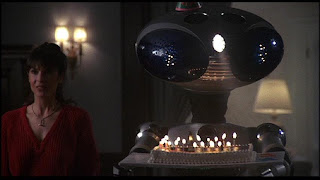
 He's super-strong, his punches deliver 1,850 pounds of force, and he's ready to take on America's best fighters, with Rocky Balboa at the top of his (well, not his, but his handlers--they do most of the talking for him) list. Before, he settles for an exhibition match with former champion Apollo Creed. This does not go well. What starts off as an exhibition fight turns into a supreme beating, with Creed dying in the ring. In his way of getting revenge, Rocky decides to fight Drago, in Moscow, on Christmas Day, for no cash purse. Talk about American sacrifice. At the start of the film, we're treated to supreme American excess, starting with the Balboa family's robot:
 And then James Brown leads a lavish gala before the Apollo Creed-Ivan Drago fight:

 Once Rocky and his trainers arrive in Russia, he establishes some shots of the Soviet landscape, some bordering on stereotype, complete with snow and stone faces:


Let's go back a few scenes: During the press conference, a verbal argument erupts between Paulie (Rocky's brother-in-law) and Drago's Soviet publicist. Again, getting into stereotypes, Paulie represents the "ugly American," while the publicist does his best to maintain Drago's equality with the best American athletes, not for a second believing that Drago will lose the fight.

 During this argument, Paulie says: "At least we don't keep our people behind a wall with machine guns." This is almost definitely a reference to the Berlin Wall, which, curiously, was not fully supported by the Soviet Union: "The wall dramatized the extent to which the Soviet Union had chained itself to a weak ally--who was able to use that weakness to get its way (138)."
It is with a reasonable degree of trepidation that I chose Rocky IV for the "Politics and Movies Blog-a-Thon." This film continued the trend of the Rocky series hitting some ups and many downs after the classic 1976 original. The fourth installment was released in 1985, and I find it to be very enjoyable, although campy at times. This notion of camp, coupled with the general agreement that Rocky IV is the most ludicrous of the franchise, makes this choice worthy of justification. The last thing I wanted was for this analysis to come across like an ironic, hipsterish elevation to "great movie" status based on its far-fetched plot. Nor did I want to aim for a Mystery Science Theater joke-fest. To justify this, I'll begin by saying that Rocky IV attempts to highlight some very clear-cut politics, balancing representations of the United States and the Soviet Union during the height of the Cold War. To help out, I read John Lewis Gaddis's book The Cold War to see if writer-director Sylvester Stallone was able to (intentionally or not) mirror on film the emotions and events of that conflict.
"By that time [1940], one historian has estimated, the Stalinist dictatorship had either ended or wrecked the lives of between 10 and 11 million Soviet citizens--all for the purpose of maintaining itself in power (Gaddis 99)." In the 1980s, while the Soviet Union had its problems, it had moved away from the serious megolomania of Josef Stalin. Soviet leader Mikhail Gorbachev wanted to maintain Socialism without violence or force (257). In terms of the film, what better way to live vicariously than through Ivan Drago, the best amateur boxer ever to emerge from the USSR?


 He's super-strong, his punches deliver 1,850 pounds of force, and he's ready to take on America's best fighters, with Rocky Balboa at the top of his (well, not his, but his handlers--they do most of the talking for him) list. Before, he settles for an exhibition match with former champion Apollo Creed. This does not go well. What starts off as an exhibition fight turns into a supreme beating, with Creed dying in the ring. In his way of getting revenge, Rocky decides to fight Drago, in Moscow, on Christmas Day, for no cash purse. Talk about American sacrifice. At the start of the film, we're treated to supreme American excess, starting with the Balboa family's robot:
 And then James Brown leads a lavish gala before the Apollo Creed-Ivan Drago fight:
 Once Rocky and his trainers arrive in Russia, he establishes some shots of the Soviet landscape, some bordering on stereotype, complete with snow and stone faces:

Let's go back a few scenes: During the press conference, a verbal argument erupts between Paulie (Rocky's brother-in-law) and Drago's Soviet publicist. Again, getting into stereotypes, Paulie represents the "ugly American," while the publicist does his best to maintain Drago's equality with the best American athletes, not for a second believing that Drago will lose the fight.

 During this argument, Paulie says: "At least we don't keep our people behind a wall with machine guns." This is almost definitely a reference to the Berlin Wall, which, curiously, was not fully supported by the Soviet Union: "The wall dramatized the extent to which the Soviet Union had chained itself to a weak ally--who was able to use that weakness to get its way (138)."
 The training sequences then turn into a sort of political mindfuck. In order to clear his head and focus on the fight, Rocky insists on living and training in the barren countryside with no luxuries, while Drago has the best science and technology as his disposal. In other words, Rocky, the great American hero, becomes a representation of Communism. He's living off the land, training by sawing logs and running in snow. In one sense, he's maintaining his Americanness by rolling up his sleeves and working up a sweat. However, he totally blends in with the peasants who live nearby.

 In the above scene, he breaks away from Communism by outrunning his KGB bodyguards, who follow his every move.


 With a the sinister Gorbachev look-a-like watching, Drago's publicist confronts the underachieving fighter, incensed that the crowd is cheering for America. This leads to the revelation that Drago does not fight for his country, but for himself. This is all good, however, because after Rocky's victory, even the Soviet Premier stands to applaud him. At this point in the film, the audience should breath a sight of relief. According to Ronald Reagan, "as long as Communists preach the supremacy of the state, declare its omnipotence over individual man, and predict its eventual domination of all peoples on Earth, they are the focus of evil in the modern world (224)."


 In the above scene, he breaks away from Communism by outrunning his KGB bodyguards, who follow his every move.


As the fight begins, more metaphors become obvious. The size of Drago overwhelms the size of Rocky, but as we all know, America will prevail. The bigger they are, the harder they fall. Eventually, Rocky's determination wins over the Soviet crowd, who start to cheer for him instead of their beloved countryman:


 With a the sinister Gorbachev look-a-like watching, Drago's publicist confronts the underachieving fighter, incensed that the crowd is cheering for America. This leads to the revelation that Drago does not fight for his country, but for himself. This is all good, however, because after Rocky's victory, even the Soviet Premier stands to applaud him. At this point in the film, the audience should breath a sight of relief. According to Ronald Reagan, "as long as Communists preach the supremacy of the state, declare its omnipotence over individual man, and predict its eventual domination of all peoples on Earth, they are the focus of evil in the modern world (224)."


Sure, there are some discrepancies that could be pointed out. For example, before the fight between Creed and Drago, Creed is wearing his boxing gloves. There's a single frame where he's not wearing his gloves, and then he has them back on again. Also, at the beginning of the film, a lot is made over the fact that the East and West have never met in sports. Um, really? In the case of Rocky IV, it's obvious, because Drago was an amateur before turning professional. Even if he didn't hail from an oppressive regime, it would have been impossible for him to fight professional American boxers. On top of that, American baseball teams played against Japanese teams in exhibition matches back in the early 1930s.
In conclusion, Stallone didn't really create a film with overt metaphors and allusions to Lenin and Stalin, but that wasn't his intention; the United States/Soviet relations provided an easy conflict to paint on the boxing ring. However, it should be considered a political movie for that reason. It caused me to research the Cold War, to learn more about it than I knew before, and therefore increased my political and historical knowledge. And, as Rocky says at the end: "If I can change, and you can change, then anybody can change."
Work Cited:
Gaddis, John Lewis. The Cold War. Copyright 2005 by John Lewis Gaddis.
Subscribe to:
Posts (Atom)
-
I recently finished reading what is normally considered Cormac McCarthy's greatest novel, Blood Meridian . While it's certainly amon...
-
 (The novel Tampa , and some of the related subject matter discussed in this review, is pretty NSFW.) "A very guilty pleasure indeed....
 -
 Translation: "There is no greater solitude than that of the samurai, unless it is that of the tiger in the jungle...perhaps..." (...